Squash Company

Squash coaching with passion

  • Squash School
  • Blog
  • Videos
  • Shop

The Ready position – Part 2: The body


Prepared to turn anywhere and change direction at any moment.

Welcome to part two of The Squash Company’s three-part special blog post on ‘The Ready Position’. ‘The Ready Position’ encompasses your racket, body and feet and is the position you should adopt between every one of your shots to give yourself the best possible chance of retrieving your opponent’s shot. Last time we looked at the role of the feet. In today’s post, we will be looking at the role of the body in ‘The Ready Position’ and how you should position yourself between shots.

Your body positioning between shots is something that is largely left alone but it is something that can provide a small advantage if done well and conversely it can leave you at a disadvantage if done badly.

The ‘Neutral Position’

People know you should recover the T-Position or T-Zone between shots, as it is the central area of the court and from here you can also control the game. It’s important to occupy the T-Position in the right way though.

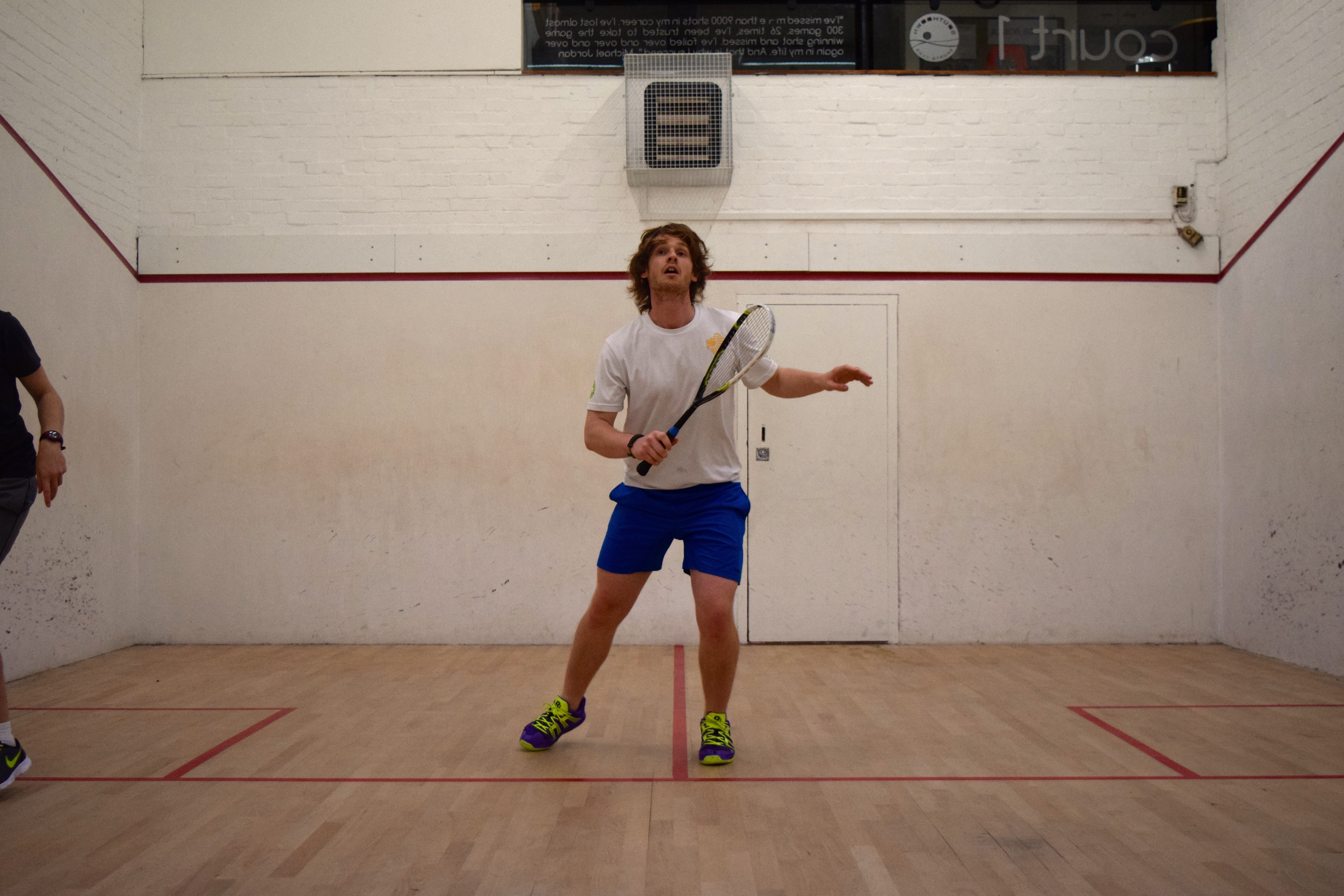
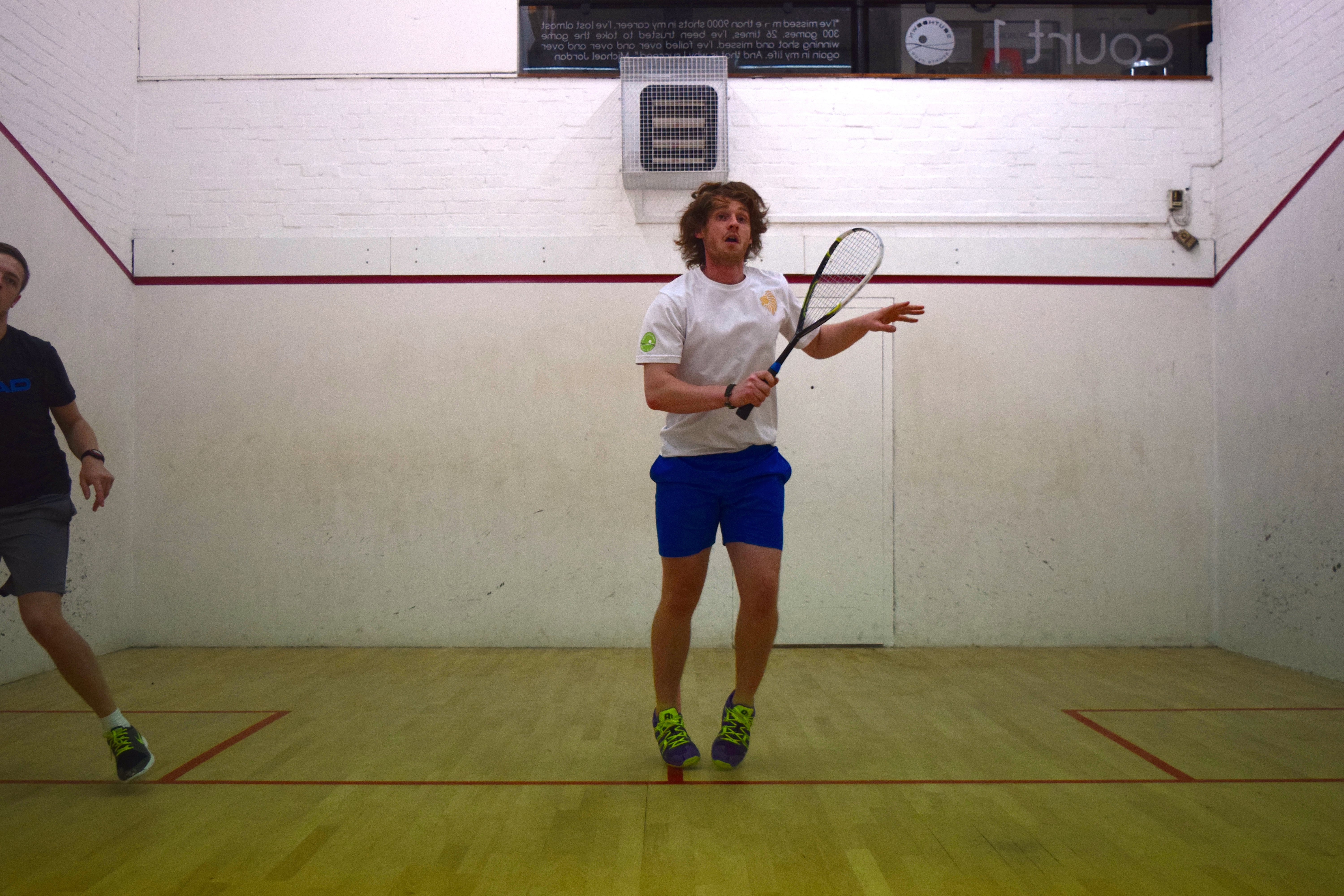
Whilst on the T-Position, you should ensure that your body is facing the front wall in a neutral position. Obviously, you don’t want to lose track of the ball though, so you must turn your head so you can watch what’s going on behind you over your shoulder.
If your body is facing the front wall, it is very easy for you to go in any direction at any time as you aren’t overcommitted. Lots of people will turn and face the back corner and their opponent or pre-empting a straight drive, will drift away from the T-Position and get caught facing the side wall. When this happens, they are very susceptible to getting caught out by a well placed boast or cross-court shot. No matter how good your anticipation (or your shot), you need to be ready for anything and by keeping your body facing the front, you are keeping open the option to move anywhere.
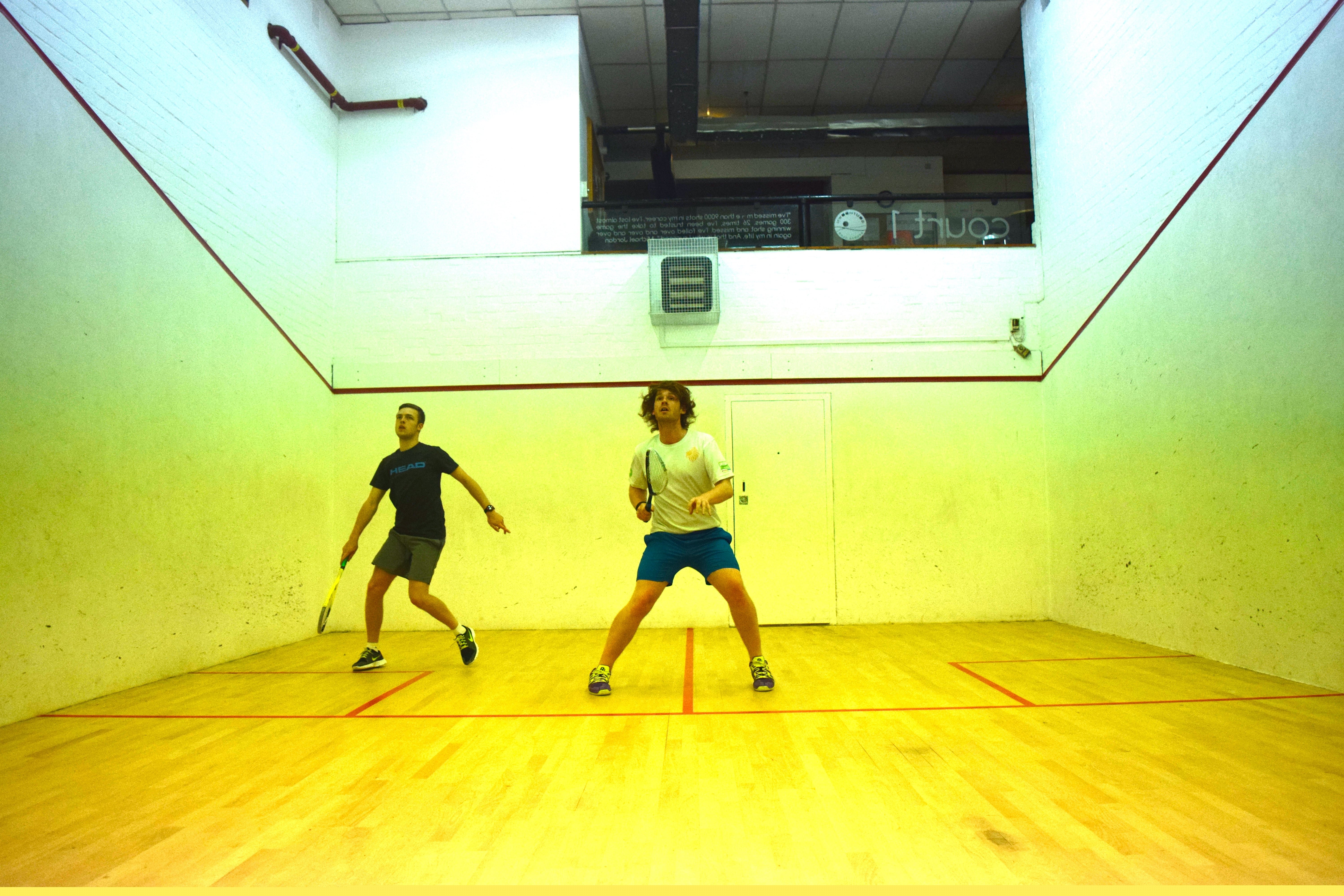
DSC_0391-min
It is no good taking the T-Position so that you can cover all areas of the court if you actually physically can’t cover the all areas because of your body positioning! Just make sure that you do turn your head and watch over your shoulder – you need at least one whole eyeball on the ball at all times!

Keep an eye out for part three of this series of blog posts in which we will look at what you should do with your racket between shots.

Filed Under: Mental, Physical, Pre-match, Tips

The Ready Position – Part 1: The Feet


Prepared to go anywhere and do anything at any moment.

Welcome to The Squash Company’s three-part special blog post on ‘The Ready Position’. ‘The Ready Position’ encompasses your racket, body and feet and is the position you should adopt between every one of your shots to give yourself the best possible chance of retrieving your opponent’s shot. In this first post, we will be looking at the role of the feet in ‘The Ready Position’. You can check out Part 2 on the body here, and Part 3 on the racket here.

In squash, footwork can be one of the hardest things to master. We’re going to look at a phase of movement and footwork that lots of people don’t even know exists, while others do it without ever realising. It takes place just before you start to move off to your next shot and is part of the ‘Pre-Flight  Stage.’

The ‘Pre-Flight Stage’

Between your shots, most players know you should aim to get back to the T-Position or T-Zone, as it is the central area of the court and a place from which you can move anywhere and also control the game. Once back on the T-Position though, there’s an important step (literally a step!) before you begin moving to the next shot and this step is very difficult to do well.

This step is the ‘Pre-Flight’ stage and to some it comes naturally, while others have never even considered it or paid it any mind.

It’s that split-second on the T-Position between the movement back from playing your shot and the movement into your next shot. That gap can be virtually non-existent or it can stretch to a couple seconds if the rally is slow paced or your opponent is delaying playing their shot to try and catch you out. What you do with this time is important to the outcome of the rally. Get it wrong and you may well find yourself chasing the ball or at worst, out of the rally in one shot.

DSC_0480

The ‘Split-Step’

You should aim to time your arrival back at the T-Position so that you are landing on the T as your opponent is about to start their swing. On your toes with your feet comfortably apart, you should then look to ‘split’. The split-step or split is simply splitting your legs apart by dropping into your legs, so that they are wider apart. As you land from this split, you look to push off in the direction of your opponent’s shot.

The reason players use the split-step is so that they can move in any direction once they land on the T-Position. If you arrive at the T-Position flat on your feet or try to push off from a standing start, you will find it very difficult to push off or change direction at speed. Whereas, if you arrive on your toes and then split-step, you can move in any direction at that moment. As you split, any movement in any direction has to be possible.

DSC_0481-min

Prolonged ready position

Sometimes, you’ll spend a longer time than normal on the T-Position despite your best efforts to time your movement to your shot. If this is the case, try your best to keep calm on your toes with your heels firmly off the floor and your feet poised gently apart. Avoid moving too soon or letting your feet go flat, as both of these will make it easier for your opponent to make you run or win the point.

Look out for part two of this series in which we will look at how you should position your body between shots, and Part 3 on what to do with your racket. 


Filed Under: Mental, Movement, Physical, Positional, Pre-match, Tips

Keeping hydrated when playing squash


Are poor hydration levels impacting your performance?

Hydration impacts significantly on sporting performance. Lots of people skip the subject saying they ‘don’t drink water’ or they ‘don’t need to drink’ and many players will go through matches without having anything more than a sip of water from a water fountain. Whether or not your realise it, it has a huge impact on your performance, especially in the latter stages. If you start hydrating yourself properly, you’ll be amazed at just how much your physical and mental performance can improve.

One very important thing that a lot of people don’t realise is that once you feel thirsty, it’s already too late. Feeling thirsty is a sign of the onset of dehydration, albeit not at a serious level which will affect your health, but at a level significant enough to impact your performance. If you feel thirsty, your concentration and physical performance will already be suffering.

Pre-Game

Before a game, it’s important to start making sure you’re well hydrated in advance. To achieve optimal performance, you need to start preparing 2 to 3 hours before that match.

The drinking during this time should be in gradual doses and you should look to consume around 400-500ml of water. This sounds like a lot but isn’t all that much when spread out across 3 hours, particularly if you are about to embark on an intense match. Just make sure you’re close to the toilet in the lead up to a match!

As well as getting in a habit of drinking sufficiently, it’s also important to take steps pre-match towards aiding your concentration and getting in the zone.

Try having a 500ml bottle with you before you play a match which you can swig from. It’s a small and easy thing to do which will make a lot of difference to your quality of performance. If you’re really serious keep a 1l bottle with you at all times!

In-Game

You only need glance down at your shirt to see how much water you’ve lost during a match. This water must be replenished. Ideally, you’ll be able to drink smaller amounts gradually after each game, rather than necking a bottle every couple of games or when you feel thirsty.

It is estimated that both the average male and female need to drink just shy of 500ml per 30 minutes of intense exercise and I would class most squash matches as intense exercise. If your match is lasting nearer to an hour, then you’ll need over 900ml of water in order to maintain peak performance, which you don’t need telling is a lot!

This amount will vary of course on how long and intense the rallies are and also will change if you are smaller than the average male or female. You’ll need to drink significantly more if you’re bigger or if you’re playing high-level matches.. These are all rather generic figures though, as some people will sweat more than others or need more water irrespective of body size and it also varies depending on several other factors, so use what works for you. What is clear though is you need to drink a lot.

I’d recommend getting a 1 litre sports bottle right away and keeping it close by during matches.

Are electrolytes real? Is Lucozade Sport really better than water?

You might be surprised (or not surprised) to find that water isn’t actually enough on its own to rehydrate properly during and after intense exercise, as you lose lots of different minerals in sweat and during exercise. ‘Electrolytes’ is a term generally used to describe potassium and sodium, amongst a few other things.

Lucozade isn’t better than water, as their slogan suggests but it does have some important properties that water lacks, although it is no good on its own and not great in pure form.

Sports drinks are important for replacing the electrolytes which your muscles will need to function but most of them contain so much sugar that they will detract vital bodily energies away from the muscles. You need sufficient amounts of these electrolytes so that the Sodium-Potassium pumps in the cell membranes of your muscles can make your muscles contract effectively. These pumps rely on keeping a higher concentration of potassium outside the cell and sodium inside the cells to make muscles contract. During the more intense rallies, potassium can move out of the cells so rapidly that there isn’t a high enough concentration in the cell to maintain balance and the muscles gradually contract with less and less power until you’re fatigued.

You need to be able to replenish the stores of these electrolytes regularly during a match in order to keep your muscles contracting efficiently, which requires a sports drink of some kind. As I just mentioned, sports drinks have too much sugar in them on their own, which is detrimental to your performance. The best way forward is to have a diluted sports drink, i.e. put some water in your Lucozade, which will help you completely rehydrate.

If you don’t replace your fluids properly with a combination of diluted sports drink and water, you will not only find that your performance suffers but also that you’ll get muscle cramps and pains a lot more readily. Being properly hydrated goes a long way in staving off these aches and pains with some research suggesting that lactic acid may not actually be the cause of the muscle ache, but too much potassium building up outside of the cell membranes of muscle cells.

So make sure you bring a diluted sports drink with you alongside your barrel of water!

Post-match

There is a reason a lot of people drink milk based drinks after exercise and that is to help rebuild muscle fibres as well as provide carbohydrates, sodium and calcium, which are all important to recovering physically from exercise. Some of the protein drinks you’ll find will often advertise an excessive amount of protein though. As with all figures it varies a lot depending on your size, gender and a few other things, but generally you only need to take in around 20g of protein and any excess tends not to be processed by the body.

However, having a big glass of milk or healthy milkshake is a good idea to boost your recovery, particularly if you are at a tournament or playing again in a short space of time e.g. within 24-48 hours.

As always, you need to drink plenty of water too.


Filed Under: Mental, Nutrition, Physical, Tips Tagged With: hydration, sports hydration, squash coaching, water

Squash’s favourite tactic: Death by straight drive


It has got my back up again to hear people talking about playing long shots and then more long shots in squash. Playing the ball to the back of the court is a fundamental part of the game and underpins the majority of rallies but on its own, playing only long, hard shots is not a style of squash for the longer term.

I’d go as far as to say drive and length shots are simply a conduit for the more attacking shots in squash. They’re played to create the opportunity to play more attacking shots, such as drops. If my opponent returned one of my drives with a weak shot, I’m sure as hell not going to play another straight drive and hit it straight back to them.

After I’ve played a good length, I’ll be hunting for an opportunity to go short or play an attacking shot, as I don’t want to prolong the rally with endless drives unnecessarily. As soon as the chance comes to go for a more attacking shot, I’ll take it, be it the second shot or the hundredth shot of the rally. You should play a drop or short shot in squash any time you get an opportunity too (although of course you should vary your shots). Otherwise, you’re wasting the advantage you’ve got by getting to the T-Position.

There are times when long length rallies are required; it’s not always easy to force a weak shot from an opponent or perhaps your opponent is simply hitting error after error and keeping the ball in play, and waiting for them to make a mistake is enough. These rallies and games shouldn’t be the norm though.

Yet some people speak about playing drive after drive as if you somehow might eventually bore your opponent to death or overwhelm them with death by drive. It irks me even more when it comes from renowned sources in the game. I’m sure they will disagree with me and they might be right, but as a person who was brought up on length and fitness, I can assure you I’d have been grateful to anyone who taught me how to hit winning shots or even discussed the idea with me! Hitting length after length and running might have been the way once but times have changed. Players need to be able to hit winners and apply pressure from all over the court. Since the introduction of Point-A-Rally, scoring the game has become more aggressive and you need to be able to finish the ball and the straight drive isn’t frequently an outright winner unless it is played with a good deal of deception or hold.

After I’ve played a good length, I’ll be hunting for an opportunity to go short or play an attacking shot, as I don’t want to prolong the rally with endless drives unnecessarily. Otherwise, you’re wasting the advantage you’ve got by getting to the T-Position.”

If you’re in any doubt, I’d ask you to consider what happens whenever a young or inexperienced player starts playing league squash. Quite often they are inexplicably beaten by wily old players with one leg. The younger player is better technically and physically than their opponent, but yet they are beaten. It happens with almost all junior players. Of course it’s because all these experienced players now accept they have no chance to compete physically, so they know they have to win the rallies quickly. So they go short at any opportunity and throw in lots of slower paced shots to keep the pace comfortable for them and to frustrate their opponent. The younger or inexperienced player toils away to get one point, only to watch their opponent rack up three or four in a matter of seconds.

What if as a sport we educated all young and new players in finishing the rally first? What if we taught all of our juniors the little boasts, the different spins, the wristy shots and actively encouraged them?

If we wait until they’re older, it’s a lot harder to integrate into their game. The day comes for everyone when they can no longer get away with fitness and speed and not necessarily because of age. For me, once I started taking on a certain calibre of players, I could no longer outlast them as they were also fit. I also didn’t have the shots to hurt them, so I was in trouble!

Playing only length might be a good game plan against certain players but it’s not a style of play for the long term. Make sure you practice finishing rallies!


Filed Under: Drives, Mental, Tactical, Tips

Building Pressure and not relying on ‘winning’ shot


Attacking the ball and playing offensively is not something that happens with one shot – it must permeate every shot you play. You can’t expect or act like any shot will be the winning one – or the losing one.

I was working with the Sussex County Squad and we were doing a session on taking the ball early. During a drill that saw a repeating pattern of shots – boast, cross-court length, straight length (aiming to volley the cross-court) – I debated with the players which shot was the most important one of the drill. Of course, all of the shots are important but not one of them initially agreed with me when I argued that the boast was the key shot in the drill. The idea of the drill was to step in and attack the cross-court as high up the court as possible on the volley, meaning that not surprisingly many of them opted for that volley attempt as being the focal point of the exercise. A few of them chose the cross-court length as this would determine whether a volley was possible or not.

The reason I argued for the boast was that if a player played a weak boast, a strong cross-court would follow making it very hard to volley. When a stronger boast was played, the cross-court was almost always rushed or weaker and therefore much easier to intercept on the volley. We watched a few rallies and sure enough a good boast often resulted in a weaker cross-court and the boaster taking charge of the rally. When a bad boast was played, we watched again and again as that player then went on to struggle for several shots, if they stayed in the rally at all, as a result of that one boast.

The boast was in truth no more important than the others but due to the fact the boast is often undervalued, it was treated as just a filler shot by participants as if it was just there to make up the numbers – a subordinate shot to the more glamorous volley. Serves and serve returns are often treated in this manner and it is a mindset we are all guilty of at times. We often look to attack our opponent with just one or two shots out of nowhere, in this case with a fantastic volley no matter the strength of the cross-court, thinking that this will be enough to win the rally or at least make it difficult for the opponent. More often than not when we do this we make errors after trying to force a shot from an impossible position or get disheartened if our opponent retrieves very good shots and we wonder what we have to do to get a point. We very rarely gear all of our shots towards taking the ball early or indeed any other tactic we are aiming to execute. We often just expect to be able to focus on hitting a couple of good shots and up the pressure. In this case, the players weren’t treating the boasts as shots that could contribute towards creating openings but instead trying to force moments of genius on the volley.

I call these inspirational shots or shots from nothing ‘moments’. Being able to produce these ‘moments’ to win points is fantastic to watch and all players should aspire to hit winning shots but this strategy is seldom successful over any period of time if it is not backed up by building good pressure. Winning at squash comes through consistently hitting the ball into open spaces, as England Squash’s ‘Pillars of Squash’ testify.

What we really need is to create sustained or relentless pressure, which was the point I tried to get across to the squad. The boast was part of a sequence or combination of shots and if the pressure was applied by one player through every shot they played, they would eventually tire their opponent, force an error or produce one of these ‘moments’ from a good position.

“Attacking the ball shouldn’t be something that happens with one shot. In order to attack the ball or take the ball early, we must gear all of our shots towards it. The attacking intent must permeate and inspire all of the shots we play. It is no good trying to step up and play one volley. You need to build pressure gradually and work the openings for you to take the ball early if you are to attack it successfully and you do this by making even the most common drives and boasts intense.”

Those who saw the importance of the boast made sure they hit it with the upmost quality or even hit a volley boast and quite quickly they began to create pressure as their opponent was forced to lunge down low very quickly, resulting in a weaker cross-court return. The weaker return was easier to volley and allowed for another attacking shot, which again could heap further pressure on a beleaguered opponent. There were times it took five or six attacking shots to finally break the opponent but it always came eventually. Even when the aggressor made an error or their opponent managed to turn the rally around, they’d been on the end of a prolonged attack and were tired from retrieving during the attack and so made more errors and poor play as time went on.

What I wanted to drive home to the players and to you now is that you can’t rely on just producing that magical shot or winning a rally with one shot. You have to string together sequences of shots and sometimes it might take several really good aggressive shots before you get the winner or force an error. If you focus on making every shot one that will increase the pressure that bit more, you will get the opportunity to hit more attacking shots and you will find yourself capable of hitting more winners as gaps begin to show as your opponent tires. You have to be prepared to up the intensity and the pressure through a number of shots in order to create a relentless cycle of pressure that eventually forces your opponent into submission.

When you play, don’t focus on one shot as being crucial. You might have one very strong shot that your game is geared to but this shot needs other shots to flourish and you must remember that. If you have a superb volley drop, you need to create pressure to force a weak shot for your drop volley. If you just focus on looking for drop volley opportunities, you will often attempt to volley very tight balls or rush the shot. If you focus instead on building the pressure and make every shot a testing one, you will find you won’t need to force the ‘moments’ but that they will flow naturally. If you make sure all your ordinary shots from your serve to your boast have intent, you will quickly be inundated with opportunities.

Make sure even your most mundane drive is testing and dripping with aggression – perhaps you hit it earlier or maybe you hit it downwards so it fades quickly in the corner. If you do that, you’ll find opportunities will open up for you to play any attacking shot you desire.


Filed Under: Mental, Tactical, Tips

  • « Previous Page
  • 1
  • …
  • 4
  • 5
  • 6
  • 7
  • Next Page »


Terms | Privacy policy | Contact | About us
Web Development By S G Barker.