Squash Company

Squash coaching with passion

  • Squash School
  • Blog
  • Videos
  • Shop

How to improve your movement to get counter drops back

I always found that having a tall and rather large build meant that I was vulnerable to counter drop or short shots; short shots which my opponent plays in response to my short shot. This was most apparent when I played a short shot from the front of the court and so was required to move into the front corner twice in quick succession; once to play my shot and then again to cover their counter.

How can you improve your movement to deal with counter short shots? 

Weight transfer is the most important thing when you are moving out of the front corner, as if you keep your centre of gravity in the right place you can leave yourself the option to move into the front again. 

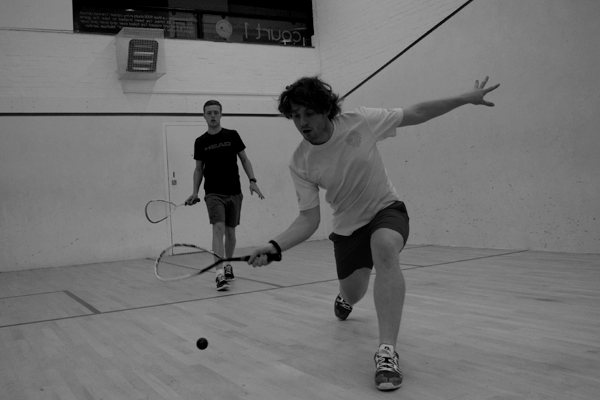
The first part of the weight transfer is the lunge, squat or planting of your legs when you go to strike the ball. If you are lunging to an extent – whether it is as full stretch or a fairly shallow lunge – try to make sure you are using your back leg and non-racket arm to help you move out of your shot. This is done by allowing your back leg to drive through towards the ball as you follow through and keeping your non-racket arm back and out to the side. The momentum of the back leg driving through and the non-racket arm’s balance can then be used to help you move out of a shot and back towards the T-Position. 
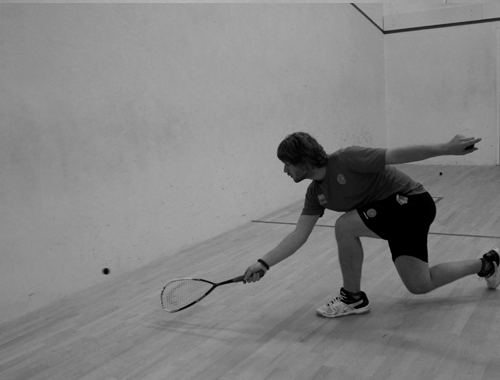
Now comes the part where you need to really watch your weight transfer. Like a sprinter moving out of the starting blocks, it is really important that you stay low as you move backwards to the T-Position. It is very easy to spring out of a lunge and end up standing completely upright, but by doing this you will shift the majority of your weight backwards towards the T-Position, thereby throwing all of your eggs in one basket and making it very difficult to go forwards again. If you ‘unfold’ yourself gradually and stand upright again only as you get back to the T-Position, you will find it easier to shift your weight and move back towards the front corner again if necessary.

Whilst you are staying low and unfolding, you need to make sure you are taking small steps back towards the T-Position. The lunge might be a big step (of course assisted by the back leg and non-racket arm), but after that, you need to make sure that your steps are small and skimming the floor. Small, low steps also help to keep your weight in a more neutral position, as when you take big steps in any direction, you are committing your weight and therefore yourself to that direction and making it very difficult to change. That won’t help at all here given you need to go back in the opposite direction to which you were previously moving. 

Moving with shorter, lower steps is comparatively easy to practice compared with the lower centre of gravity, which can take a bit more practice and awareness. Ghosting and practicing the movement pattern is a very good way to start so that you can really feel the size and height of your steps, and also where your weight is as you move. You can then build that up by having someone feed you shots to the front corner, then the front corner and the back corner in a fixed order and lastly the front and back corner at random. You can then swap sides and add in more shots to make it more match-like.

One final thing; it can also help to change your grip as you move towards the ball. As you are taking your first step towards the front corner again, shift your hand down your grip to the very bottom of the handle in order to give yourself a touch more reach. You can read more about that on our post here.

Best of luck in maintaining a low centre of gravity and covering the front corners repeatedly! 
Filed Under: Drops, Movement, Physical, Positional, Technical, Tips Tagged With: counter drop, how to move in squash, low centre of gravity, movement, retrieving counter drop, return counter drop, return drops

Do you actually get back to the T-Position? 

Or just part of the way?

Most people learn fairly early on in squash that you should try to get back to the T-Position, but do people actually get back to the T-Position? 

The ‘true’ T-Position

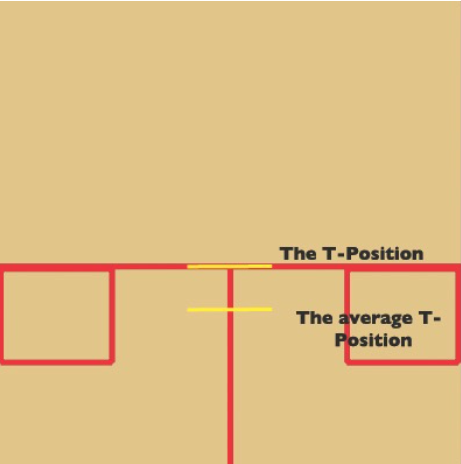
Generally, most players will get back towards the T-Position but not actually recover all the way to it. The ‘true’ T-Position, as everyone probably knows but forgets, is where the short-line meets the T-Line or serve line on the floor, which creates the ’T’ shape known as the T-Position. In some matches and on some courts during high temperatures, this might not be too damaging, but it certainly prevents you from fulfilling your potential.  

When it’s hot and there are lots of hard length shots being hit it might be sensible to not return all the way to the T-Position, but recovering to the ‘The average T-Position’ (pictured above) will give your opponent opportunities and also deny you key opportunities. 

The benefits of recovering to the true The T-Position include:

  • Being in position to create and use volley opportunities more often and earlier
  • Being able to cover short shots better 
  • Being able to do more damage with short shots by playing them earlier

Some players might think that they can volley enough from a deeper position, but the truth is even if you volley a lot from a deep position you will be missing some opportunities which could do even more damage to your opponent. The shots you are volleying will be hit half a second or a second later than you would be hitting them if you were on the T-Position. You shouldn’t underestimate the difference this can make. It puts so much more pressure on your opponent physically, which in turn puts pressure on their technique and mental game, all of which they’ll have to cope with in a faster paced game that will sap their energy. 

Your opponent is being let off if you are not taking advantage of these benefits. Who doesn’t like their opponent taking their time and not applying pressure? These opportunities are presented to your opponent if you are allowing them to take the T-Position by sitting deep behind the T. Then, you allow them more time to play a better shot, and because you aren’t in a great position to volley, you will probably be pushed to the back of the court and lose possession of the T-Position, which will then give them the chance to reap the benefits of the advanced T-Position. 

Pay attention to your T-Positioning the next time you go on court. Are you getting back to the T-Position as well as you can? Or are you comfortable to play against?

Filed Under: Movement, Physical, Positional, T-Position

Who can handle the oxygen debt best?

When you play someone who is at a similar or higher standard of ability and fitness to you, you will often spend much of the match in oxygen debt.

What is oxygen debt?

Oxygen debt occurs when your body isn’t able to get sufficient oxygen around the body quickly enough. The main symptom of oxygen debt is heavy and quick breathing, and unfortunately in squash you don’t get much time to let your breathing calm down. Soon after a tough rally is finished, the next one begins. 

How will it affect the match?

You’ll never quite become comfortable physically in a tough match, which means a lot of the game becomes about who can cope with their oxygen debt the best. This is especially important the better a player you become and at a high club or county level. At this level, the match can often become a question of who can maintain their skillset, shape, technique and shot selection best under the pressure. Naturally, a big part of playing at a high level is learning how to handle and adapt to being in oxygen debt.

Recognising when you need to change your game

It sounds obvious that everyone should know when they are tired, but quite often players will go into oxygen debt on auto-pilot, and start playing sloppily without really knowing it. They’ll instinctively be tempted to start going for ultra-attacking shots and try to cut rallies off early, which can be effective if you are still able to move your feet sufficiently to get into a good position. Quite often though, positional play becomes really sloppy when you are tired and so forcing an attacking shot isn’t a good idea. More subtle signs of oxygen debt include your length often starts bouncing shorter, which will create other problems if you are unable to get the T-Position back and giving your opponent a chance to attack. 

Signs you have become affected by oxygen debt include:

  • Not recovering to the T-Position, or not recovering the T quickly enough 
  • Length shots bouncing short
  • Trying to win the rally really quickly
  • Attempting to play spectacular shots that aren’t really an option 
  • Slow recovery between rallies
  • Sustained heavy breathing
  • Hitting the ball out more than normal
  • Shots losing accuracy

Some of these are very obvious, but you must act the moment you notice one of these things, or any other symptom of tiredness, affecting your game. 

How to adapt – using the height of the court 

  • Mentally re-focus, and remind yourself what you want to achieve: 
    • Hitting length higher and slower
    • Attacking earlier in the rally, but still not forcing attacking shots

The first thing is to stay calm, which can take a bit of doing, and avoid trying to win rallies immediately. After that, it’s important you focus on your length shots, as accurate length which gets your opponent behind you will help you to handle a lot of the problems that oxygen debt brings. 

Start by aiming a bit higher on the front wall with your length – hit slower drives and go for more lob shots – as this will help you still get your length shots to the back of the court, but also give you a bit more time to recover to the T-Position. This deals with two of the major problems of oxygen debt. If you are managing to get the ball to the back of the court with high slow shots, and therefore get your opponent behind you, you will also typically get more opportunities to attack and intercept their shots, which means you don’t need to force attacks and take big risks in the pursuit of winning rallies.

When you are tired, you can and should try to win rallies when the opportunity arises. Trying to play lots of winners can be a very good strategy when it works, but it is high risk when you’re tired and not moving your feet well. The key to getting the right balance with winning shots is to attack earlier in the rally where possible, but not to force opportunities. Try to ensure that you are going for the majority of these winning shots once you have moved your opponent behind you – ideally with your high, slow lob – as you would in the majority of the match. The aim is to try and take the first or second opportunity you get, perhaps a loose length shot from your opponent that you can volley, rather than being more patient and waiting to see if you can create a better opportunity. You need to stop trying to keep moving your opponent and instead focus on being clinical as soon as a chance presents itself. This doesn’t mean forcing a winning shot, as it might take dozens of shots for you to get an opportunity, but don’t pass that opportunity up when it does come, be it the fourth or fiftieth shot of the rally. 

Start by recognising you are in oxygen debt, stay calm, aim to get the ball to the back of the court in any which way, and then go from there. Let us know how it goes below! 

Filed Under: Matchplay, Physical, Tactical, Tips

How to play against good retrievers

The key thing when playing someone who retrieves the ball very well is patience. It is very natural to try and make your shots even better and go for the spectacular ones to win the rally; to try and hit drops a little lower, or attempt shots that aren’t really on. However, this strategy will typically lead to errors and therefore increased frustration for you. 

Expect them to return your shots

The mindset necessary to beat someone like this is to expect them to get all of your shots back. Do not be disturbed if they retrieve a shot which would normally win a rally. If they return your shot, then you simply play another one, and another one, and another one, until the rally is over. Be prepared for this to last several games; if they are retrieving a lot, it is likely they retrieve a lot in matches in general and so they will have a high level of fitness from all the running they do. 

Your aim is to keep them moving. You need to keep playing quality shots and going short when the time is right – as you need to make the court big for good retrievers by hitting the ball into open spaces – but without trying to hit the winning shot. This can be a fine balance though, as you don’t want to play drops or other attacking shots too high either in attempting to avoid making a mistake. 

Deal them a mental blow by remaining unbothered by their retrieving 

If you expect them to return every shot, you will not only prepared for them to return the shot mentally, you would also be prepared positionally as you’ll already be moving ready for them to get the ball back. If they don’t return the ball, it is a bonus, but always expect them to. This way you will not be rattled or concerned, which helps you mentally during the match and will also damage them mentally if they don’t think you are threatened by their retrieving. 

A lot of fitness is mental, and if they start to feel mentally concerned or wearied by you prolonging the rallies and not being affected by their retrieving, it may take the energy out of them and they might struggle to keep retrieving the ball as well. As mentioned earlier, this might take one, two or even three games or more to achieve against very fit retrievers, but most players have a point where their fitness will be sapped by their mind if you can reach it. 


Are their shots as strong as yours?

This is a bit of a generalisation, but if a player is relying on retrieving, they are likely to not be as accurate with their shots as other players playing at a similar level, otherwise they wouldn’t be relying on speed and fitness. If this is the case, be sure to push home your advantage. The key to this, as with a lot of things in squash, is to make sure your length is accurate and clears the service box every time. You should do this with a combination of straight drives, lobs and straight long volleys, and not rush to go short until the moment is right. This might mean not taking the earliest opportunity, but waiting for a better one to present itself, which it will if you are more accurate than them, and you allow this to show by being patient.

Using delay and putting the ball back from where it came 

Good retrievers often sprint a lot, and you can use this against them. If they are sprinting a lot to get back to the T-Position, their weight will be fully committed in the direction of the T-Position, and this will make it very hard for them to slow down and change direction. For example, if they retrieve a drop shot, they will often turn and sprint back towards the T-Position, meaning they will find it very difficult to turn around and retrieve another drop shot if you play it. If they are sprinting to the T-Position from the back of the court, they will often find it hard to return to the back if you play a length again, especially if you play a long volley, which is why using that straight long volley mentioned in the last paragraph is important.

Try out our tips and let us know how you get on!


Filed Under: Mental, Physical, Tactical, Tips Tagged With: fit, fit players, retriever, retrieving, squash tactics, tactics

What to do when the game tied at 1-1

We’ve previously written about handling a match when you are leading 2-0, and another really common and pivotal situation during a match is when the match is tied at 1 game each.

Knowing when to push

When the match is tied at 1-1, the third game becomes vital for both players. Lose, and you need to win 2 games in a row for the first time in the match in order to win. It’s not just a physical challenge but a mental one as well. If the player losing 2-1 is also struggling physically or not as fit as the other player, the disappointment of losing the third and facing up to needing to win two games in a row might be too much for them and they might struggle to find anything like their best.

This is why you need to throw everything you’ve got at your opponent at the start of the third game.  Before you go on court for the third game, set targets for yourself or remind yourself of how you want to play. Remind yourself, and force yourself if necessary, to push high up the T-Position, to volley and take the ball early, and tell yourself that you will not let them win two rallies in a row or allow the ball to bounce twice. If you work better with targets, aim to keep them at 0-0 for as long as possible, or see how few points you can limit them to. Once you are in the game, remind yourself of your goal or target between rallies but do not dwell on the actual score – let that take care of itself.


Even doing this just for the first half of the third game might be enough to demoralise your opponent or give you an unassailable lead.

Investing in the third for reward in the fourth 

If you don’t go on the offensive in the third, and instead maintain a steady level – or worse drop off – you will give your opponent a big chance to go 2-1 up if they come out attacking, which is a position you really don’t want to allow them to get into. Working yourself as hard as possible in the third is often a good investment, as if you can win a really tough third game to go 2-1 up, the extra effort will be rewarded when your opponent is worn out physically, and therefore not capable of being truly competitive or dangerous in the fourth game.

If you are in a match poised at 1-1, double your efforts. Every game is always important but leaving yourself needing to win back to back games deep into the match is not a position you want to be in. You can also deal a devastating blow to your opponent and leave them physically unable to put as much into the fourth game, which when combined with the disappointment of losing the third, can allow you to ease to victory in the fourth providing you maintain your concentration.


Related posts:

Being 2-0 up: The 2-0 up syndrome

Don’t wait for the ball – hit it early

What to do at match ball 

Play like it’s a best of one

Complacency

Filed Under: Mental, Physical, Tactical, Tips

  • 1
  • 2
  • 3
  • …
  • 5
  • Next Page »


Terms | Privacy policy | Contact | About us
Web Development By S G Barker.