Squash Company

Squash coaching with passion

  • Squash School
  • Blog
  • Videos
  • Shop

Return serves into the four corners!


Claiming the T-Position at the start of the rally. 

A lot of rallies are decided before they’ve really even begun during the serve and return of serve phase.

Most people realise the benefits of volleying an opponent’s serve and most people are able to volley the majority of serves after playing for a while but people don’t always consider what sort of volleys they are playing or where they are hitting the ball too.
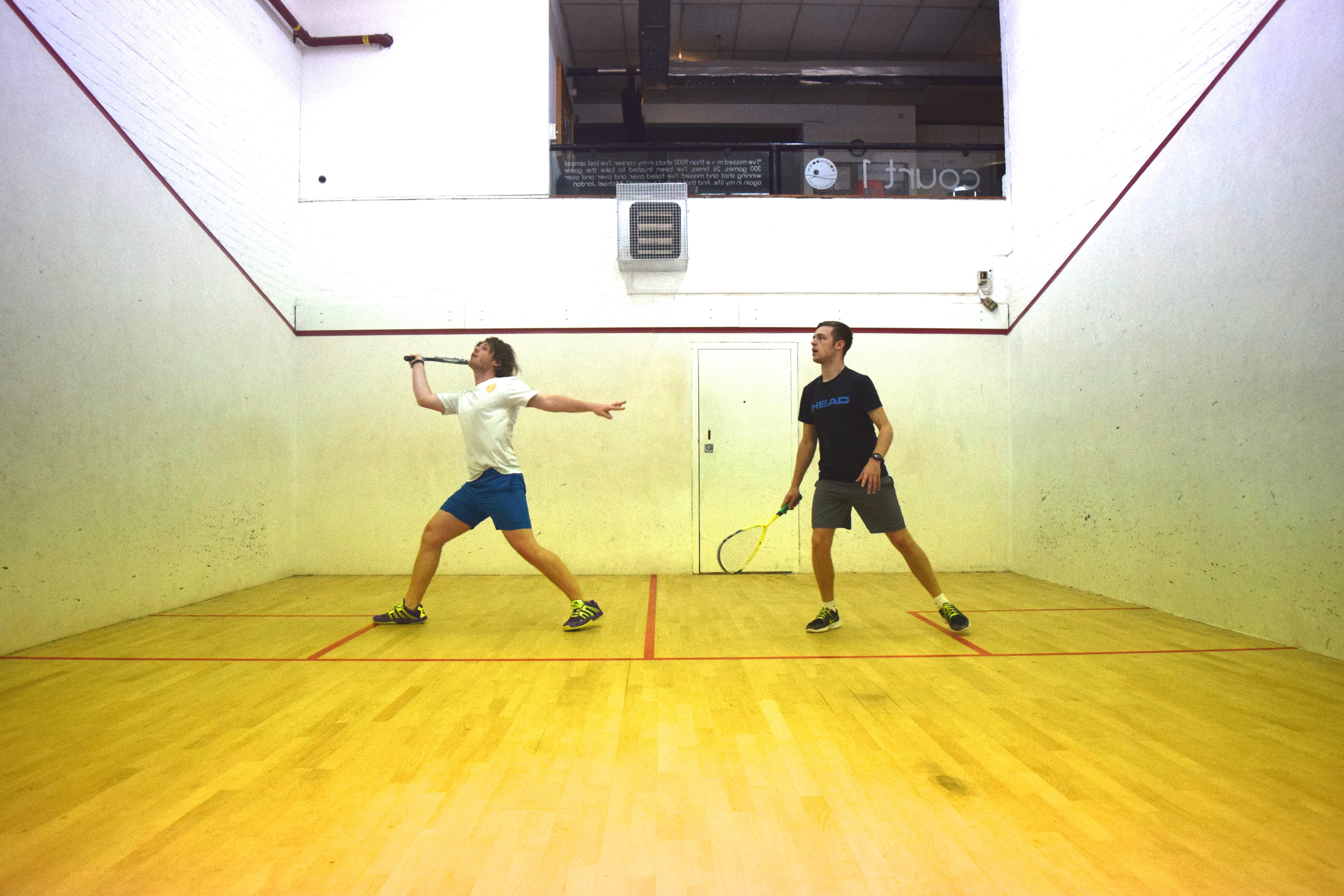
Hitting the four corners

It sounds very simple and possibly very boring but most serves should be volleyed into one of the four traditional corners of the court (some have argued for their being eight or more ‘corners’). By volleying the serve into one of these corners, you are forcing your opponent away from the T-Position. When your volley doesn’t reach or go to one of the four corners, it is much easier for your opponent to get to your shot and they will be far more likely to retain the T-Position, which is bad news for you. If you play a loose return or return to the middle, you will likely find yourself under pressure immediately against a stronger player or even that you have lost the rally after the next shot.

Personally, I think the majority of your serve returns should be straight long volleys, as this is the shot that when played well will get you to the T-Position and get your opponent behind you, which is the perfect start to any rally (except for hitting the nick). The cross-court volley and short volley are good return options to use sparingly to catch your opponent out but both need slightly more accuracy or they will sit up nicely for a well placed opponent. The volley lob is a particularly nice option if your opponent plays a high lob serve.

Using boasts or kills

If you go for boasts, kill shots or simply hit an inaccurate shot which ends up anywhere near the middle of the court, you won’t move your opponent away from the T-Position as much. Kills and boasts can be effective returns if you are able to catch your opponent over anticipating and moving to one side of the court very early. This is typically best done on occasion as your opponent won’t be expecting such a shot or if you disguise your intentions well.

Have a good look at your return of serve and see if it is helping you get off to a good start to rallies or if it is actually leaving you vulnerable early in the rally. There are lots of players out there who play well once they get into the rally but often don’t make it that far because their serve or return isn’t of a high enough standard. Don’t be that player – practice and improve your serve and return.


Filed Under: Return of Serve, Serves, Tactical, Tips, Volley

Is your long shot actually long? 


Does your length shot get your opponent behind you?

It can be very easy to get caught up in whacking the ball to the back of the court with little regard for accuracy and thought for why you actually did it. The whole point of playing a long shot is to get your opponent behind you so that you can take the T-Position. Do your length shots actually have this purpose?  

Getting the first bounce behind the serve box

In general, you need the first bounce of your shot to be behind the serve box. The exact area of the ideal first bounce will vary though depending on the court, the ball and what shot you are playing. It’s wise to spend a bit of time during the warm-up trying to figure out where the ideal first bounce is to get the ball bouncing twice right in the back corner. Sometimes it will need to be a good foot behind the service box or possibly even further back that that if the ball is cold or your are playing a slower shot, such as a lob.

Even on the hottest courts, you will usually need the ball to bounce behind the serve box to get your opponent off the T-Position. If it doesn’t get beyond the box, you will usually find your opponent is able to cut the ball off. It might mean the ball comes off the back wall a bit but this is definitely worth it to get your opponent off the T-Position (so long as your length shot isn’t coming off the back wall a long way!).

Most matches are won by the player who gets their shots into the corners of the court the most and if your length is getting your opponent to the back more than their length shots are able to get you to the back, you will have a great chance of emerging victorious in the match.

Ways of getting the ball behind the service box

If you’re struggling to get the ball behind the serve box it can be for a number of reasons. Typically people could do with opening their racket face more, which you can do by rotating your forearm. You can find out more about this here.

It might also be your positioning and/or footwork is preventing you getting enough power or leverage on the ball, in which case you might need to ensure your feet are pointing towards the sidewall or even a touch forwards, which might mean moving around the ball more to ensure you are more ‘side-on’ to the front wall. You might even use a little jump. You can find out more about positioning and footwork here.

You could also try putting more weight into your legs by bending your knees more and squatting slightly or lunging, although this lunge needs to be directed by your feet and body pointing towards the side wall as much as possible as previously mentioned.

During your next few matches, check if your length shot actually gets past the service box. The player whose length is weaker and shorter typically loses the match, as they don’t get possession of the T-Position as much and provide their opponent with more opportunities to attack.


Filed Under: Drives, Lobs, Positional, T-Position, Tactical

Don’t wait for the ball – hit it early


Don’t gift your opponent time

A foot is a huge distance in squash. A second is a long time. If you stand a foot higher up the court or hit the ball a second earlier, even a half-second, it has a huge knock-on effect and changes the pace of the game. If you hit the ball level with the T-Position, as opposed to being nearer the back of the service box, that might be the difference between catching your opponent unaware and unprepared and catching them perfectly calm and positioned on the T-Position. Both of these scenarios would lead to drastically different rallies and outcomes for you and your opponent.

Doing everything earlier or higher up the court

The big opportunity that lots of people miss on court is when their opponent plays a long shot from the front of the court. Rather than stepping forward and volleying, many will move back and let the ball bounce. Some will volley, but often they’ll do so well behind the short line and T-Position or not volley as early as they could have because they were sloppy in recovering the T-Position.

If there’s ever an opportunity to hit a shot earlier or higher up the court do it, take it. If you let the ball bounce or travel further down the court, you are allowing your opponent time. It might be a small amount but it could make all the difference. Hitting the ball an inch higher up the court might leave them with too much ground to make up. Not hitting the ball that inch higher up may result in them scraping your shot back with their frame.

If you are struggling with hitting the ball early or being ready to hit the ball early, try practicing the volley exercises below:

As with any sport or pursuit, you really need the margins in squash. Any marginal gain is worth fighting for and time and distance are the biggest of them all. Don’t allow your opponent any time you don’t have to give them – play every shot as early and high up the court as you are able to do.


Filed Under: Physical, Positional, T-Position, Tactical, Volley

Cross-courting with discipline 


Changing direction at the optimum moment. 

One thing that drives coaches, team mates and spectators batty everywhere is players (usually juniors) hitting the ball cross-court too much. Quite often for squash players, hitting the ball cross-court is the path of least resistance. You don’t need to move your feet as much to play cross-court, which means it is quicker to play the shot and therefore you don’t need as much time.

Players rarely come off better as a result of this trade-off between reduced effort and having to play a cross-court shot. The player may use less energy and save themselves some time but they also typically gift their opponent an opportunity to attack when the cross-court doesn’t reach the required area of the court.

Showing the straight drive

The cross-court length can be one of squash’s great attacking shots when used effectively. The optimum time to use it is when an opponent is anticipating a straight shot, particularly from the back, and so starts to edge towards the back corner to get ready for a straight length shot. At this point, the cross-court length is incredibly damaging, as the player has already begun to move in the opposite direction. The best way to get players to start moving towards the straight length shot is to use the cross-court length sparingly, so that they feel the straight shot will be your most likely shot choice. This naturally then makes your cross-court all the more effective when you do use it.

Cross-courting from a position of strength 

Personally, I think the key to getting the cross-court length right is to play it when you are in a position of strength. Most of the time people flap and play a cross-court shot if they are unsure or under a bit of pressure, because as we mentioned earlier, it is always an easy shot to hit. Logically, this is a disaster as the shot is likely to be inaccurate if played while under pressure, which means it is likely to be looser and in the middle of the court and in an area where the opponent can intercept it comfortably.

Be the one who changes the direction of play with the cross-court, but only on your terms. Only change it when you are in a strong position and preferably when your opponent is vulnerable, as in the previous paragraph where they may be anticipating a straight ball and are already on the move.

Turning your opponent

When playing your cross-court you need to aim to turn your opponent towards the back corners. If your cross-court doesn’t get behind them, then it’s likely to give them an opportunity to volley or put you under pressure. So ensure when you do play cross-court that you get the depth to really turn your opponent towards the back of the court to limit their options significantly.

Never cross-court unnecessarily. Cross-courts are great attacking shots when your opponent leaves a gap but they should be used at the right time and at the right moment; always from a position of strength.


Filed Under: Disguise, Drives, Tactical, Technical, Tips

Play it simple


Often the obvious shot is the best one. 

It’s very easy to get carried away and overcomplicate any sport in the modern era with all the analysis software, video footage and media platforms available. As coaches, who may be paid to make a living, it is very tempting and perhaps even expected, to build complex webs, terms and concepts around a discipline. Squash doesn’t always get the same level of analysis as some sports, but it is still a simple game which can be easily complicated. It’s actually oh so simple.

Play the obvious shot

If someone is behind you, play it short. If they are in front of you, play it long. Don’t be worried that they will know what you are doing. The real question is, will they get it back? And even if they do get it back, did they have to work hard to get it back?

It’s very easy to try and be too clever and look to start bluffing and double bluffing, but on the majority of occasions, you should just play the obvious shot that they know you are going to play and you know you are going to play.

I’ve talked before in the post ‘Skilled Player Problems’ about how I’ve been in situations where I’ve overcomplicated rallies. I’d put someone in the front corner, they’d play a loose cross-court length to me and rather than just playing a straight length shot and making them run, I tried to be clever. I would attempt to delay my shot, trying to get them to start moving to cover the straight length shot and then suddenly play it cross-court so that they would get their legs all in a tangle. I often either played a poor cross-court, played a cross-court to a strong volleyer or just allowed them time to get back on the T and get settled. If I’d just pushed it to length rather than trying to humiliate them, I might have won the rally instantly.

Make an educated guess about your opponent’s location 

You won’t always know exactly where your opponent is, but you can always make an educated guess. Usually you will be relying on where they were most recently. For example, if you played a straight drive to the forehand back corner and your opponent scraped back a boast to the opposite front quarter, you will know your opponent must be somewhere between the forehand back corner and the T-Position. If they are particularly fast or hasty, they might even be rushing toward the forehand corner. You need to make a quick, educated guess on their rough location and then put the ball somewhere else. In this instance, the straight drop shot is still the best option in the majority of situations, as it’s going to make them run hard. Occasionally, maybe two or three of every ten shots, you might play a drive, lob or another shot to keep them on their toes. You won’t always get the educated guess right no matter how good you get, but you will learn the more you try. The most important thing is you make a quick and clear decision about what shot you are going to hit.

Squash is easy but it is also easy to overcomplicate it. Keep it simple and make quick judgements about where your opponent is or should be and then hit a shot into where the empty space will be on court.


Filed Under: Mental, Tactical

  • « Previous Page
  • 1
  • …
  • 3
  • 4
  • 5
  • 6
  • 7
  • …
  • 10
  • Next Page »


Terms | Privacy policy | Contact | About us
Web Development By S G Barker.