Squash Company

Squash coaching with passion

  • Squash School
  • Blog
  • Videos
  • Shop

The Blind Spot   


Laying traps for your opponent.

There’s a short window in squash when all players lose track of their opponents, no matter how clever or aware they are. It’s that moment when you go to strike the ball and begin swinging. At that point the ball becomes your entire focus and you tend to stop worrying about your opponent and become ‘blind’ to them. If you’re particularly composed you might be able to listen for your opponent’s footsteps but in truth you’re basing your awareness of their positioning on their last known movements.

Window of opportunity

During this small window of time when an opponent is playing a shot, there is an opportunity for cunning players to lay a trap for their opponent by taking advantage of this ‘blind spot’ where the player striking the ball has no real idea of their whereabouts.
This can be particularly easy to do when returning serve, as there is a bit more time to compose yourself to lay the trap than in other situations where there might be lots more running and pressure. You might stand really high up as you wait for the return as if you’re overly eager to play a volley. If your opponent is astute, they will notice this and should then look to catch you out with deeper lob serve. While they’re executing this lob serve, you could then shuffle back into a more normal position perfectly ready to deal with their lob serve, which of course you were hoping for all along.

One opponent of mine caught me out with a body serve down the middle on my forehand and after that I started to purposely drift to the right to offer him a great opening for a body serve to see if I could get him to do it again. As he went to swing, I quickly shuffled back so that I was perfectly ready to deal with what was now a weak serve and put the ball away for an easy win.
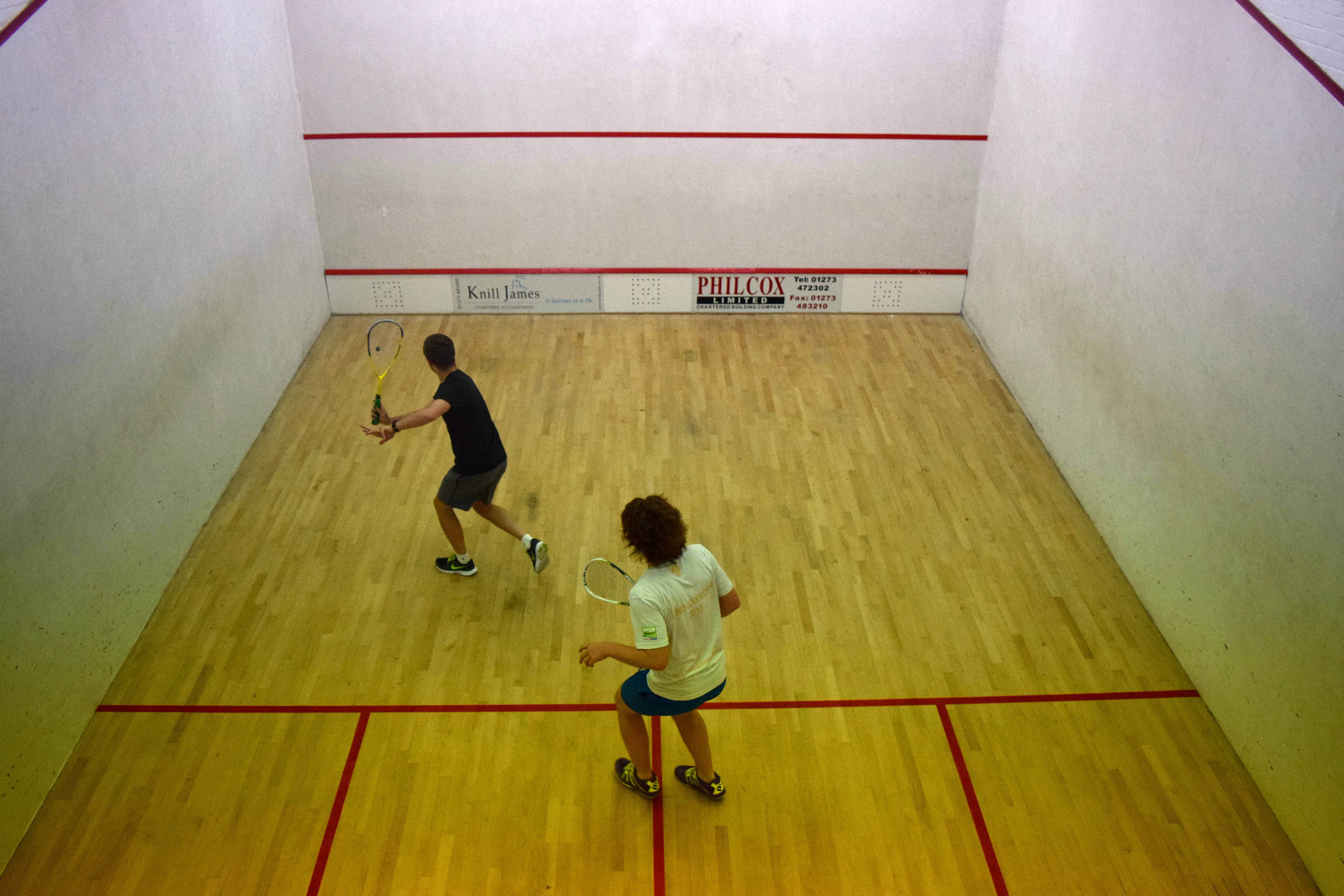
DSC_0238

By offering such an obvious gap or opening for the ball to go into, you are in effect coercing your opponent and influencing them to play a particular shot which you can then prepare for. Perhaps you can influence them to play a shot to an area which is a strength of yours.”

I saw a player once who would play a weak boast from the back and then move really high up the court, inviting the drive. He then used his speed and great volleying skill to drop back just as the opponent entered their blind spot and was about to start swinging and countered their drive shot with a long volley to the back, which often proved to be the winning shot. In this case, he was using his opponent’s blind spot to his advantage. The examples of positions you might take up and the shots you could invite are endless. You could lean to one side of the court to invite the cross-court and then pounce on the volley, you could sit deep to invite a short shot from the back and then move in for an easy drop during the blind spot and many more.

You do have to have a reasonable amount of agility in some of these examples but even if you aren’t the fastest, there’s no reason you can’t sway your opponent’s decision making with clever movement, particularly on the serve.

Have a go and see if you can control your opponent’s next shot by offering them what seems to be an easy shot option, only to then move into a strong position as they enter their blind spot and focus solely on their swing and hitting the ball.

Filed Under: Mental, Tactical, Tips

Being ‘front-on’ in the front of the court


In squash, it’s important to have different shot options wherever you find yourself on court and perhaps even more important to make your opponent think you have multiple shot options.

The front of the court 

Being in front of your opponent in the front half of the court is one of the most advantageous positions to be in, in squash. From here you have the entire court open to you and you also have your opponent’s full attention, which enables you to use deception and disguise to great effect.

There are numerous ways of being more deceptive but one quick way is to play as many shots as you can from a ‘front-on’ position. To be ‘front-on’ in the front corner means to have your body and chest facing the front wall as you strike the ball, in contrast to the traditional ‘side-on’ position where your body is facing the side wall as you strike the ball.

DSC_0043

Being ‘front-on’ has numerous advantages. Typically, it is quicker to get into this position but perhaps more pertinently, from this position it is easier to play cross-court shots meaning you can play to the whole court with greater ease than when side-on. With this in mind, it is very difficult for your opponent to anticipate what your shot will be, which will leave them under increased pressure.”

The other major benefit for deception and disguise is that it makes you physically bigger, as we talk about in another blog post ‘Using your body to disguise shots’. By being front on, you are capable of blocking your opponent’s view of the ball, which means they can quite literally lose track of the ball, which is of course a major advantage.

It isn’t all positive though, as the reason players are encouraged to be ‘side-on’ is for improved control. When you are front on, it is often far more difficult to control the ball and keep your shots accurate, particularly when going for a straight shot, so there is some trade-off to playing a shot from a ‘front-on’ position. At times, this trade-off is worth it, especially if you’re short on time or if your opponent plays a weak shot and you can hide the ball from their view but at other times, you can’t beat being side-on.

Have a few goes on it and see when and how being front on at the front works for you!


Filed Under: Disguise, Positional, Tactical, Tips

‘Keep the ball up one shot longer than your opponent’


A Primitive playing style but sometimes that last ditch shot is the winning one. 

I didn’t like the phrase when I first heard it and I still think it’s a rather crude and primitive way of playing the game. I’m not a big fan of attritional squash and I don’t think it’s a long-term way of playing personally but it does have a time and a place.

One of my early coaches imparted this one liner to me and whilst I can be pompous about it, it is undeniably true. No one who has kept the ball up one shot longer than their opponent, at least in the eyes of the marker, has ever lost a rally.

A focus when lacking sharpness 

I was reminded of that line this week as I returned to court for the first time in nearly a month after holiday and found myself making a lot of poor decisions and not hitting my target areas of the court. Despite a poor first game riddled with errors and sloppy movement, I decided that it would be better to keep going and practice my aggressive play, as I judged it would just take me time to get sharp again and I should play through it, which is a fair argument. It didn’t stop me from losing the match soundly that day though or the next day as I was beaten again in similar circumstances. Without much court time behind me, I just wasn’t finding the touch or accuracy I needed with any of my short shots or length on a consistent basis.

It’s amazing how many times you retrieve a good shot by just getting your racket on the ball or with a loose shot at full stretch, which  your opponent should put away, but instead they hit the ball in the tin because they got sloppy thinking they’d won the rally.”

It wasn’t too much of a problem, as it was just a training game after all. However, thinking more pragmatically, in order to improve my chances of winning the game, I should have adopted a more pragmatic approach and focused on keeping the ball alive. I just wasn’t sharp enough to get in the proper positions necessary to attack effectively, which meant I essentially forcing my shots and naturally made a lot of unforced errors. Cutting out the errors, I might well have won the match.

Secondly, if I’d kept the ball up more, I would have had more shots in general during the rallies, which would’ve also been significantly longer. The more shots I had, the more practice I would’ve got and the sharper I would’ve been from the practice. After all, the best practice is the practice that provides you with the most chances to hit the ball. With a few more shots under my belt, I might well have found myself starting to find my range and accuracy a bit more.

SH13068-min

Everyone has got to have that steel about them no matter how skilful a player they are and there are always times when you simply need to keep the ball up and keeping that ball up just once more can often prove the difference.

It’s amazing how many times you retrieve a good shot by just getting your racket on the ball or with a loose shot at full stretch, which  your opponent should put away, but instead they hit the ball in the tin because they got sloppy thinking they’d won the rally.

Sometimes, you just need to keep that ball up one shot longer than your opponent.


Filed Under: Physical, Tactical, Tips

Squash’s favourite tactic: Death by straight drive


It has got my back up again to hear people talking about playing long shots and then more long shots in squash. Playing the ball to the back of the court is a fundamental part of the game and underpins the majority of rallies but on its own, playing only long, hard shots is not a style of squash for the longer term.

I’d go as far as to say drive and length shots are simply a conduit for the more attacking shots in squash. They’re played to create the opportunity to play more attacking shots, such as drops. If my opponent returned one of my drives with a weak shot, I’m sure as hell not going to play another straight drive and hit it straight back to them.

After I’ve played a good length, I’ll be hunting for an opportunity to go short or play an attacking shot, as I don’t want to prolong the rally with endless drives unnecessarily. As soon as the chance comes to go for a more attacking shot, I’ll take it, be it the second shot or the hundredth shot of the rally. You should play a drop or short shot in squash any time you get an opportunity too (although of course you should vary your shots). Otherwise, you’re wasting the advantage you’ve got by getting to the T-Position.

There are times when long length rallies are required; it’s not always easy to force a weak shot from an opponent or perhaps your opponent is simply hitting error after error and keeping the ball in play, and waiting for them to make a mistake is enough. These rallies and games shouldn’t be the norm though.

Yet some people speak about playing drive after drive as if you somehow might eventually bore your opponent to death or overwhelm them with death by drive. It irks me even more when it comes from renowned sources in the game. I’m sure they will disagree with me and they might be right, but as a person who was brought up on length and fitness, I can assure you I’d have been grateful to anyone who taught me how to hit winning shots or even discussed the idea with me! Hitting length after length and running might have been the way once but times have changed. Players need to be able to hit winners and apply pressure from all over the court. Since the introduction of Point-A-Rally, scoring the game has become more aggressive and you need to be able to finish the ball and the straight drive isn’t frequently an outright winner unless it is played with a good deal of deception or hold.

After I’ve played a good length, I’ll be hunting for an opportunity to go short or play an attacking shot, as I don’t want to prolong the rally with endless drives unnecessarily. Otherwise, you’re wasting the advantage you’ve got by getting to the T-Position.”

If you’re in any doubt, I’d ask you to consider what happens whenever a young or inexperienced player starts playing league squash. Quite often they are inexplicably beaten by wily old players with one leg. The younger player is better technically and physically than their opponent, but yet they are beaten. It happens with almost all junior players. Of course it’s because all these experienced players now accept they have no chance to compete physically, so they know they have to win the rallies quickly. So they go short at any opportunity and throw in lots of slower paced shots to keep the pace comfortable for them and to frustrate their opponent. The younger or inexperienced player toils away to get one point, only to watch their opponent rack up three or four in a matter of seconds.

What if as a sport we educated all young and new players in finishing the rally first? What if we taught all of our juniors the little boasts, the different spins, the wristy shots and actively encouraged them?

If we wait until they’re older, it’s a lot harder to integrate into their game. The day comes for everyone when they can no longer get away with fitness and speed and not necessarily because of age. For me, once I started taking on a certain calibre of players, I could no longer outlast them as they were also fit. I also didn’t have the shots to hurt them, so I was in trouble!

Playing only length might be a good game plan against certain players but it’s not a style of play for the long term. Make sure you practice finishing rallies!


Filed Under: Drives, Mental, Tactical, Tips

The return of the three wall boast


As I talked about in a previous post, the traditional three-wall boast has been falling out of favour in modern squash, making way for a vicious two-wall boast, which bounces twice before the third side wall and is tricky to retrieve. However, the three-wall boast is now experiencing something of a renaissance in the professional game in a different guise.

Players are still trying to avoid hitting defensive three wall boasts but they are now using the three wall boast as a jarring, time-buying abomination of a shot. Rather than meekly hitting a defensive boast when in a bad position, players are now drilling the boast as hard and high as they can. 

They’re not trying to play a trick shot or attempt a skid-boast (a high fast boast where the ball is played from one back corner of the court with the aim of landing it in the opposite back corner) though but at the same angle they would use for a traditional defensive boast.

The effect it has is that it drives the opponent back. It’s such a headache to deal with coming in hard and high and straight to the middle of the court. Players are usually taken aback by the shot and unsure of how to deal with it, often leading to a weak shot or bad shot choice. Not only does it buy the perpetrator of the shot time but it commonly puts them on the offensive as the other person is shocked.

It’s important you are able to play different variations of common shots in squash. If you play the same boast every time during a squash match, you’ll find yourself becoming predictable. Alternating between aggressive two wall boasts, more subtle trickle boasts and these jarring, hard three wall boasts will give such variation to your game that an opponent will struggle to gain a foothold against you.

Make sure in your practices and matches that you work on different types of boasts and ways of hitting the shot – you’ll be rewarded for it. Who knows, you might even invent a new way of hitting the boast!

Want to know more about how to play a boast?


Filed Under: Tactical, Technical, Tips

  • « Previous Page
  • 1
  • …
  • 6
  • 7
  • 8
  • 9
  • 10
  • Next Page »


Terms | Privacy policy | Contact | About us
Web Development By S G Barker.