Squash Company

Squash coaching with passion

  • Squash School
  • Blog
  • Videos
  • Shop

Do you vary your serve in squash?


Vary your serve to disrupt your opponent’s momentum with your service in squash.

When it comes to practice and training in squash, serves are almost always neglected. Think about it: this is absurd. The serve begins the rally. It is possibly the most important shot in the game; it determines whether you will be on the front foot or the back foot at the start of the rally, which often defines the course of that rally.

The serve is also unique. Unlike any other shot in the game, you can take your time with a serve. You can take a few seconds to pick your spot and line up your shot and that little bit of thinking time can be crucial.

My question to you is do you vary your service? Most players tend to have one serve they favour the majority of the time they serve, usually either a smash serve (a fast, low serve) or a lob serve (slow, high serve).

Whilst serving doesn’t directly provide points in the same way it does in sports like Tennis, we all have experienced a player with a tricky serve that makes life uncomfortable for us. Often it is the older gentleman with the awkward lob serve that seems to just drop in the back corner never to be seen again. Even against these lob serve merchants though, we gradually adapt. We get to the stage where we are able to handle and deal with their serves. We might not like it but we are able to eventually produce efficient returns, unless there is a gulf in playing standard.

No matter how good your serve, if it becomes predictable, people will learn to deal with it. Of course, if you have a great lob service, you should make it the staple of your service game but every now and then, throw in a few smash or body serves just as your opponent is starting to come to grips with the height and pace.
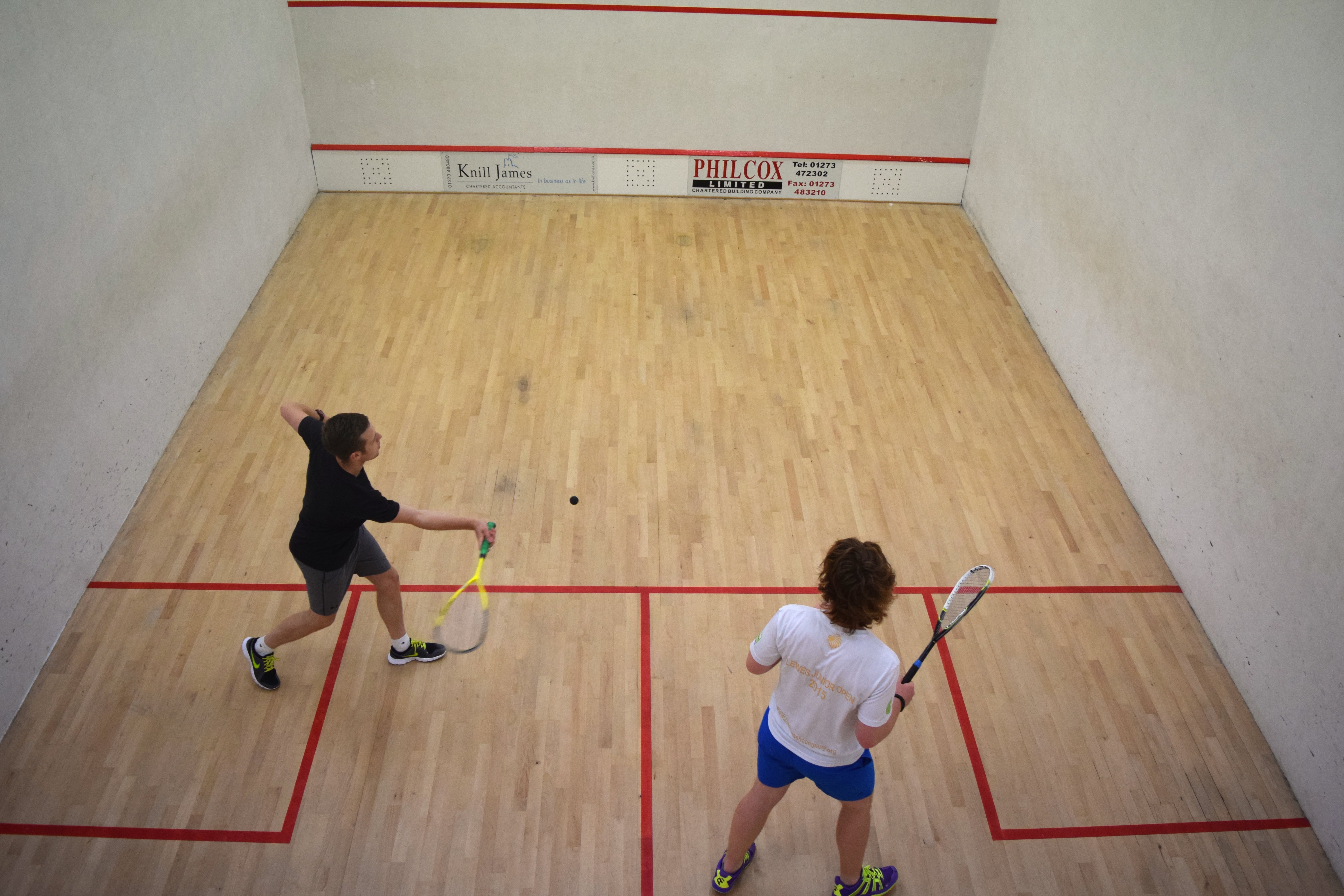
serve-5-min

If you watch your opponent’s positioning as they await your serve, you will notice it is very pragmatic. They will adjust based on your most recent service patterns. If you have been serving high and slow, they may push forward looking to volley it high up or they may drop back looking to take it lower if they have been struggling to cope with the height of the ball.

No matter how good your serve, if it becomes predictable, people will learn to deal with it. Of course, if you have a great lob service, you should make it the staple of your service game but every now and then, throw in a few smash or body serves just as your opponent is starting to come to grips with the height and pace.”

Look for these subtle adjustments and when you spot them, change your serve again to catch your opponent cold. The aim is to keep pulling the rug from under their feet every time they think they are getting a stable footing with your serve. This can keep them perpetually defending with their first shot of the game, which is a massive advantage for you. An old adversary of mine saw me moving too early preparing for a volley return on my forehand and so he used to elect to serve to my forehand first and drill the serve down the middle and it caught me out. It just goes to show you need to consider the angle of your serve based on your opponent’s positioning and vary it accordingly.

It is particularly important you vary your serve against players who look to win points regularly with their serve return. These are typically players with a strong drop volley or nick-shot and are often able to score several points a game with their shot. If you keep varying your serve and use a good dose of all of the three major types of serve – the lob, smash and body (when the serve is played down the middle towards your opponent) – you will severely limit this weapon and frustrate them. It disrupts their rhythm, as a few awkward serves can lead to a few scrappy rallies and cheap points, which can derail an opponent who previously had the momentum.

In the post ‘Which side should you serve to first?’, we discuss another thing you can do to vary your serve, which is serving to different sides to gain an advantage. Give it a go! See what benefits can be had from trying to vary your serve.


Filed Under: Return of Serve, Serves, Tactical, Tips

Which side should you serve to first?


Should you serve to your opponents backhand? 

Whenever we play squash, we almost always serve to our opponent’s backhands and make a point of doing so. If we see a left-hander, we almost immediately proceed to the left hand service box and begin our service. Is this right though and which side should you serve too?

At a lesser level, players tend to be weaker on their backhand so it makes sense to try and get an easy point by serving to an opponent’s backhand, particularly when playing English Scoring to 9, where you need to be serving to score a point.

I challenge you to think before you automatically plump for serving to your opponent’s backhand.

So at a lower level, serving to the backhand seems a sensible idea. At many levels PAR (Point-A-Rally) scoring is now universal and this diminishes the importance of being the server – though not the importance of the quality of the serve.

Regardless of the scoring system, players still serve to their opponent’s backhand, despite the fact there is no real logic to this at a good playing standard except for custom, as there is less difference between the backhand and forehand of a player. In fact, many players become better at hitting touch shots on their backhand.

With this in mind, I challenge you to think before you automatically plump for serving to your opponent’s backhand. First, consider your own service. Is your service stronger when serving to the backhand side or the forehand side?

I challenge you to think before you automatically plump for serving to your opponent’s backhand.”

Which side should you serve to first
Make sure you consider the pace, angle, height, etc., of your serve based on your opponent’s positioning.

Secondly, what sort of positioning does your opponent take up when waiting for the serve? One player I played regularly thought he saw me moving too early preparing for a volley return on my forehand and so he used to elect to serve to my forehand and drill the serve down the middle, towards my body and it caught me out. Now though, I pretend to drift over as if I’m moving in too quickly, only to shuffle back waiting for his loose serve when he’s not looking!

Make sure you also consider the pace, angle, height, etc., of your serve based on your opponent’s positioning.

Thirdly, consider your opponent’s strengths. Some players attack and volley better on their backhand than their forehand. So why would you serve to their stronger volleying side?

Lastly, consider the mental effect this can have on your opponent. Whenever someone served to my forehand with their opening serve, I was curious and almost lost concentration. ‘Why is he doing that? My forehand is stronger than my backhand… isn’t it?’. ’What has he seen? He must have seen something on my forehand that he thinks he can exploit. What does he know?’. ’Is his serve stronger on that side?’.

Consider your opponent’s strengths. Some players attack and volley better on their backhand than their forehand. So why would you serve to their stronger volleying side?”

It might even lead other dangerous thoughts; ‘Right, my forehand is stronger than my backhand. I’m going to smash this into the nick to show him just how wrong he is to challenge me on this side.’ Whatever the reaction was, it was just that, a reaction. Even if it didn’t show outwardly, I was at least slightly distracted inwardly. It is worth serving from different sides every now and again in a match just to psych-out your opponent. This is particularly effective against players with strong return of serves and players who are reliant on them (the serve & drop volley merchants!). Disrupt their rhythm by keeping them guessing about the serve.

Next time you serve, don’t just head for the same box as always. Think about it. The serve gives you the time unlike any other shot to do just that. You can also read more about service in the post ‘Do you vary your serving?’.


Filed Under: Return of Serve, Serves, Tactical, Tips

Building Pressure and not relying on ‘winning’ shot


Attacking the ball and playing offensively is not something that happens with one shot – it must permeate every shot you play. You can’t expect or act like any shot will be the winning one – or the losing one.

I was working with the Sussex County Squad and we were doing a session on taking the ball early. During a drill that saw a repeating pattern of shots – boast, cross-court length, straight length (aiming to volley the cross-court) – I debated with the players which shot was the most important one of the drill. Of course, all of the shots are important but not one of them initially agreed with me when I argued that the boast was the key shot in the drill. The idea of the drill was to step in and attack the cross-court as high up the court as possible on the volley, meaning that not surprisingly many of them opted for that volley attempt as being the focal point of the exercise. A few of them chose the cross-court length as this would determine whether a volley was possible or not.

The reason I argued for the boast was that if a player played a weak boast, a strong cross-court would follow making it very hard to volley. When a stronger boast was played, the cross-court was almost always rushed or weaker and therefore much easier to intercept on the volley. We watched a few rallies and sure enough a good boast often resulted in a weaker cross-court and the boaster taking charge of the rally. When a bad boast was played, we watched again and again as that player then went on to struggle for several shots, if they stayed in the rally at all, as a result of that one boast.

The boast was in truth no more important than the others but due to the fact the boast is often undervalued, it was treated as just a filler shot by participants as if it was just there to make up the numbers – a subordinate shot to the more glamorous volley. Serves and serve returns are often treated in this manner and it is a mindset we are all guilty of at times. We often look to attack our opponent with just one or two shots out of nowhere, in this case with a fantastic volley no matter the strength of the cross-court, thinking that this will be enough to win the rally or at least make it difficult for the opponent. More often than not when we do this we make errors after trying to force a shot from an impossible position or get disheartened if our opponent retrieves very good shots and we wonder what we have to do to get a point. We very rarely gear all of our shots towards taking the ball early or indeed any other tactic we are aiming to execute. We often just expect to be able to focus on hitting a couple of good shots and up the pressure. In this case, the players weren’t treating the boasts as shots that could contribute towards creating openings but instead trying to force moments of genius on the volley.

I call these inspirational shots or shots from nothing ‘moments’. Being able to produce these ‘moments’ to win points is fantastic to watch and all players should aspire to hit winning shots but this strategy is seldom successful over any period of time if it is not backed up by building good pressure. Winning at squash comes through consistently hitting the ball into open spaces, as England Squash’s ‘Pillars of Squash’ testify.

What we really need is to create sustained or relentless pressure, which was the point I tried to get across to the squad. The boast was part of a sequence or combination of shots and if the pressure was applied by one player through every shot they played, they would eventually tire their opponent, force an error or produce one of these ‘moments’ from a good position.

“Attacking the ball shouldn’t be something that happens with one shot. In order to attack the ball or take the ball early, we must gear all of our shots towards it. The attacking intent must permeate and inspire all of the shots we play. It is no good trying to step up and play one volley. You need to build pressure gradually and work the openings for you to take the ball early if you are to attack it successfully and you do this by making even the most common drives and boasts intense.”

Those who saw the importance of the boast made sure they hit it with the upmost quality or even hit a volley boast and quite quickly they began to create pressure as their opponent was forced to lunge down low very quickly, resulting in a weaker cross-court return. The weaker return was easier to volley and allowed for another attacking shot, which again could heap further pressure on a beleaguered opponent. There were times it took five or six attacking shots to finally break the opponent but it always came eventually. Even when the aggressor made an error or their opponent managed to turn the rally around, they’d been on the end of a prolonged attack and were tired from retrieving during the attack and so made more errors and poor play as time went on.

What I wanted to drive home to the players and to you now is that you can’t rely on just producing that magical shot or winning a rally with one shot. You have to string together sequences of shots and sometimes it might take several really good aggressive shots before you get the winner or force an error. If you focus on making every shot one that will increase the pressure that bit more, you will get the opportunity to hit more attacking shots and you will find yourself capable of hitting more winners as gaps begin to show as your opponent tires. You have to be prepared to up the intensity and the pressure through a number of shots in order to create a relentless cycle of pressure that eventually forces your opponent into submission.

When you play, don’t focus on one shot as being crucial. You might have one very strong shot that your game is geared to but this shot needs other shots to flourish and you must remember that. If you have a superb volley drop, you need to create pressure to force a weak shot for your drop volley. If you just focus on looking for drop volley opportunities, you will often attempt to volley very tight balls or rush the shot. If you focus instead on building the pressure and make every shot a testing one, you will find you won’t need to force the ‘moments’ but that they will flow naturally. If you make sure all your ordinary shots from your serve to your boast have intent, you will quickly be inundated with opportunities.

Make sure even your most mundane drive is testing and dripping with aggression – perhaps you hit it earlier or maybe you hit it downwards so it fades quickly in the corner. If you do that, you’ll find opportunities will open up for you to play any attacking shot you desire.


Filed Under: Mental, Tactical, Tips

Five ways to improve your squash game now


Our Coaching Philosophy

Every player is different. Styles, techniques and strengths vary but we like to give the players we work with a basic framework for their play based on some of our playing principles and philosophies.

The philosophies below are, in our view, the five most fundamental lessons to learn if you want to become an excellent squash player. They are: ‘taking the ball before the back wall’, ‘going in short straight regularly’, ‘hitting the ball where the opponent is not’, ‘using deception’ and ‘hitting winning shots’.

Taking the ball before the back wall

Those of you that have read Matthew Syed’s book ‘Bounce’ will be familiar with the story of the England Table Tennis team’s reaction experiment at Brighton University. Desmond Douglas was English Table Tennis champion on eleven occasions and also made it to No. 7 in the world and was renowned the speed at which he played.
However, when he participated in a reactions test staged by Brighton University, he performed the worst of any member of the England Table Tennis set-up, including the youngsters. The test was laughed off; how could a player who played at such lightning pace have slow reactions? It was dismissed initially as a failed experiment. Only the experiment wasn’t a failure, it was right; Desmond Douglas had poor reactions.

How then did he become one of the greatest players in the world, let alone one so famed for his reactions? Delving into his background helped to answer some of the questions. Douglas grew up playing table tennis in a cramped room where there was so little room behind the table, he had to stand and play with his stomach pressed up against the edge of the table. This lead to him being forced to react quickly and hit the ball early or he simply would not be able to play a rally. What might have been seen as a disadvantage in terms of facilities actually became a formidable advantage for him. After years of playing this way, he was so used to playing in that style that when he played others on a normal table, he seemed to have supernatural reactions and take the ball incredibly early as he was so used to playing that way from his club. It wasn’t his physical attributes that contributed towards his ability to take the ball so early but rather his nurturing and the circumstances in which he learned the game.

We are trying to promote the squash equivalent. We play a lot of no back wall games to encourage all of our players to take the ball before the back wall in order to decrease the amount of time their opponents have between shots. This doesn’t necessarily mean volleying the ball; we do a lot of work encouraging our opponents to launch counter-attacking drops, boasts and drives from just behind the service box. Players that get used to playing without a back wall will experience a similar journey to Desmond Douglas and begin to take every ball before the back wall as a matter of course. They will apply phenomenal pressure to their opponent by constantly depriving them of valuable recovery seconds with every shot they play. They begin to seem like they have incredible movement and speed to the back corners, when in actual fact, some of them are quite slow in basic terms.

Going in short

It is never too early to go short. Be it a drop, drop volley or a kill shot, you should never turn down an opportunity to go short when it is on, even if it is your first shot of the rally. Too often players continue to play to length when their opponent is already behind them, which when you think about it is nonsensical. The point of a drive shot is to get in front of your opponent and look for weaker return which you can attack.

We always like to encourage our players to look out for opportunities to go in short whenever they get the chance to do so. Constantly recovering balls from the front corners is tiring for anyone and when played well, the shots all stay tight and so remain very tough to retrieve or hit the nick. It does take a bit of practice playing lots of drops and drop volleys, particularly from further back in the court but we believe it is a worthwhile pursuit. It is a tactic that pays dividends when it comes to winning rallies with outright winners and when the opponent becomes fatigued from lots of retrieving at the front of the court.

Hitting the ball where the opponent is not

Squash is a simple game. We as coaches, like everyone, are often guilty of overcomplicating things. So we try to have a simply philosophy and that is that the number one rule of squash is to ‘hit the ball where the opponent is not’. It’s not always as simple as it sounds as in the heat of the game it is easy to be unsure of our opponent’s location and we can often resort to hitting the ball without much thought or consideration. However, with some practice it becomes second nature. You can watch for and listen out for your opponent and if you are unsure of their exactly location, we look for our players to have default reactions. If they are in front, they should look to go short, as even if the opponent reads it and recovers the ball, they will have used more energy than if recovering a length shot.

It takes a bit of practice to stay composed enough to make that split-second evaluation but the difference it makes is incredible. Always hit the ball away from your opponent.

Deception

We always try to teach our players how to disguise their shots and deceive their opponents as they are learning how to play the shot. That way they can learn early on to incorporate deception into their shots, which means they are able to make mundane shots winning ones and find ways to finish off rallies from early in their development. This means they are not only able to play shots capable of winning rallies on a regular basis but they are also thinking a lot about the workings of shots. We try to put deception and creativity in as early as possible as it is much harder to learn to be deceptive at a later stage having already become settled with a particular stroke.

Hitting winning shots

With much of the game moving over to PAR (Point a rally) scoring, it is more important than ever for players to be able to hit winning shots to score points. As such, we think it is important players are taught how to end rallies through deception, strategy and hitting the nick. As part of this, we believe all players should attempt to develop proficiency in every stroke imaginable, including those that might usually be regarded as trick shots or luxury shots, as learning all sides of the game is the best way to promote true understanding, as well as creativity. We have also seen in recent years how players such as Mohamed El Shorbagy, Ramy Ashour and James Willstrop have regularly played outrageous and adventurous shots to such great success they are almost now considered a standard shot, whereas before a volley nick might have been consigned to showboating and exhibition matches.


Filed Under: Tactical, Technical, Tips Tagged With: coaching, coaching philosophies, squash coaching

Hitting the nine corners (or 10? Or more?)


Making use of all available space.

Traditionally, most people think of there being four corners on the court into which we attempt to play the majority of our shots; the two front corners and the two back corners. This can be a very efficient tactic and can even be very exciting when the drops and drop volleys are played to a high level. However, some opponents are fantastic when moving in a straight line but not so good when forced into other areas of the court or when there are lots of cross-court shots. You need to be able to think outside of just these four corners in order to be a well rounded player.

This is a concept Nick Matthew touches upon in his book ‘Sweating Blood’ and it is something which is really important to bear in mind when you are building the rally.

In the anecdote, the idea is presented to Nick Matthew of hitting the ball into ‘eight corners’. Are there eight? Are there more than eight? So where are these eight ‘corners’? These eight are not all ‘corners’ in the traditional sense. There are of course four areas into which you can play effective winners – the four corners we’ve previously mentioned.

In addition to these four traditional corners, when trying to achieve good length, we could play more lob shots, as well as hammering the ball at a low height on the front wall. We could even aim for a middling height at a medium pace. We should also throw in more extremely low shots, such as kill or stun shots. It’s better to have a few different shots that achieve the same goal, such as hitting to length, as this keeps our opponent on the back foot. These varying shots will all hit slightly different areas of the court – the kills and stuns will bounce shorter than a traditional length shot but further back than a drop – which will keep our opponent moving under more pressure as they struggle to keep up with the range of shots played.

Using slightly different shots to force opponents into different areas of the court used will force them away from smooth movement to and from the main four corners, which will almost leave them slightly disorientated.”

You could also play such a wide range of boasts to make better use of the middle areas of the court. The boast could be traditional and hit three walls, coming back off the side wall, or it could be so narrow that it hits the front wall very close to the corner. As I discussed in the post ‘Two-wall or three wall boasts?’, it may also hit the front wall in the middle and therefore bounce twice before the side wall, putting the opponent under pressure.

You can also take a few liberties and play a few shots down the middle in classic Geoff Hunt style! Be careful when you do this though, you’ll need to really sell the deception to avoid giving away strokes.

There are probably several more areas that you can think of and you should try to use as many of them as possible. The court is a rather big place and the walls have humungous surface areas. Ask yourself if you’re really making use of all of the space that is available to you.


Filed Under: Tactical, Tips

  • « Previous Page
  • 1
  • …
  • 7
  • 8
  • 9
  • 10
  • Next Page »


Terms | Privacy policy | Contact | About us
Web Development By S G Barker.