Squash Company

Squash coaching with passion

  • Squash School
  • Blog
  • Videos
  • Shop

The return of the three wall boast


As I talked about in a previous post, the traditional three-wall boast has been falling out of favour in modern squash, making way for a vicious two-wall boast, which bounces twice before the third side wall and is tricky to retrieve. However, the three-wall boast is now experiencing something of a renaissance in the professional game in a different guise.

Players are still trying to avoid hitting defensive three wall boasts but they are now using the three wall boast as a jarring, time-buying abomination of a shot. Rather than meekly hitting a defensive boast when in a bad position, players are now drilling the boast as hard and high as they can. 

They’re not trying to play a trick shot or attempt a skid-boast (a high fast boast where the ball is played from one back corner of the court with the aim of landing it in the opposite back corner) though but at the same angle they would use for a traditional defensive boast.

The effect it has is that it drives the opponent back. It’s such a headache to deal with coming in hard and high and straight to the middle of the court. Players are usually taken aback by the shot and unsure of how to deal with it, often leading to a weak shot or bad shot choice. Not only does it buy the perpetrator of the shot time but it commonly puts them on the offensive as the other person is shocked.

It’s important you are able to play different variations of common shots in squash. If you play the same boast every time during a squash match, you’ll find yourself becoming predictable. Alternating between aggressive two wall boasts, more subtle trickle boasts and these jarring, hard three wall boasts will give such variation to your game that an opponent will struggle to gain a foothold against you.

Make sure in your practices and matches that you work on different types of boasts and ways of hitting the shot – you’ll be rewarded for it. Who knows, you might even invent a new way of hitting the boast!

Want to know more about how to play a boast?


Filed Under: Tactical, Technical, Tips

Using the ‘wrong’ leg when the ball gets behind you


Cheating the back corners

I’m a bit of stickler when it comes to movement and I’m incredibly fussy when it comes to ghosting and movement training. Whilst you’ll end up in all sorts of unplanned positions in a game, I like to always strive for perfection. However, when you are in a bad position you still have to be able to play a good quality shot or you won’t last a single rally.

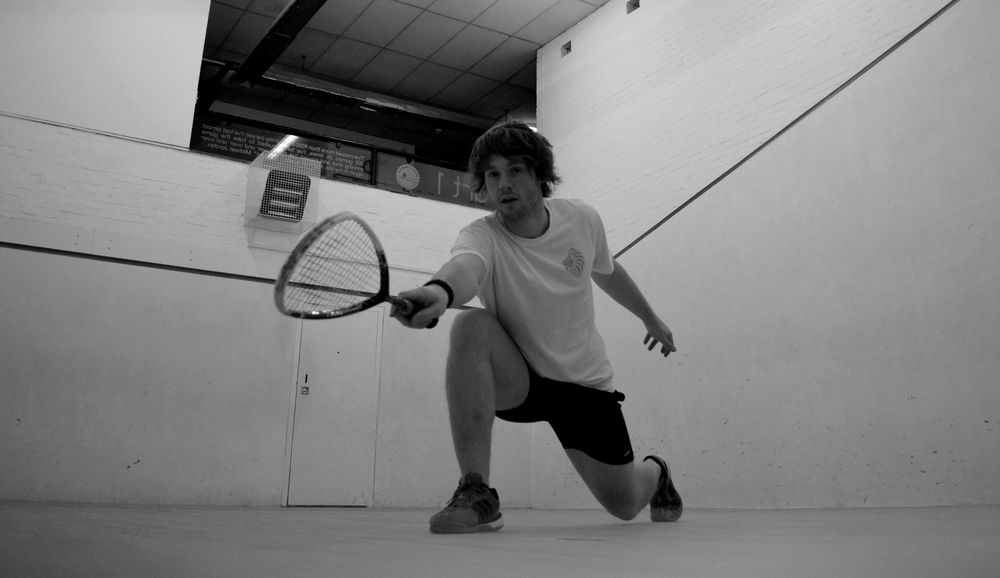
When you are in a bad position, one of the best things you can do is to use the ‘wrong’ leg. By the term ‘wrong’ leg, I mean the leg which you won’t see used in the text book on how to play squash. On the right hand side of the court, the ‘wrong’ leg would be the right leg and on the left hand side, the ‘wrong leg’ would be the left leg.

Anyone who has had coaching will be familiar with the idea of using the left leg on the right hand side and the right leg on the left hand side to maintain a position facing the side wall and stay balanced.

This shouldn’t be treated as dogma though. If you watch any high level squash you’ll see all sorts of leg positions being used for different shots and this should be encouraged and practiced. It can be a quicker option and even a necessity in the heat of a match.

It’s in the back corner though that I find the ‘wrong’ leg is most useful. Inevitably, you’ll find the ball getting past you on occasion and you’ll have to hit it when it’s behind you to stay in the rally. It’s not ideal but you have to make the best of this bad situation. The best thing you can do at this point is to lead with the wrong leg. By doing this, you can shift your weight so that it is behind the ball again, which will give you a decent amount of energy to transfer through the ball when you strike it and you’ll consequently have more options and won’t have to resort to flicking the ball back with your wrist. If you try to lead with the ‘correct’ leg, the right leg on the left hand side and left leg on the right hand side, you’ll find yourself having to really flick the ball with your wrist, which is rarely consistently reliable or accurate.

When you are in a bad position, one of the best things you can do is to use the ‘wrong’ leg. By the term ‘wrong’ leg, I mean the leg which you won’t see used in the text book on how to play squash. On the right hand side of the court, the ‘wrong’ leg would be the right leg and on the left hand side, the ‘wrong leg’ would be the left leg.”

It will feel very weird at first if you’re not used to doing it but you should practice it regularly as part of ghosting and hitting drills or match play. One easy game you can do to practice this is to play all to length on one side of the court with a partner and just practice using the wrong leg so it starts to feel a bit more normal. Equally, when you do ghosting or movement practice, practice leading with both feet and also with the feet together.

Dealing with shots in the back corner is always a mountain for any improving player, so get out there and take the first step by using the wrong foot! You can also find more tips about dealing with shots in the back corner using your racket face and spin in the post ‘How to deal with back corner shots in squash’.


Filed Under: Physical, Positional, Racket Manipulation, Technical

Five ways to improve your squash game now


Our Coaching Philosophy

Every player is different. Styles, techniques and strengths vary but we like to give the players we work with a basic framework for their play based on some of our playing principles and philosophies.

The philosophies below are, in our view, the five most fundamental lessons to learn if you want to become an excellent squash player. They are: ‘taking the ball before the back wall’, ‘going in short straight regularly’, ‘hitting the ball where the opponent is not’, ‘using deception’ and ‘hitting winning shots’.

Taking the ball before the back wall

Those of you that have read Matthew Syed’s book ‘Bounce’ will be familiar with the story of the England Table Tennis team’s reaction experiment at Brighton University. Desmond Douglas was English Table Tennis champion on eleven occasions and also made it to No. 7 in the world and was renowned the speed at which he played.
However, when he participated in a reactions test staged by Brighton University, he performed the worst of any member of the England Table Tennis set-up, including the youngsters. The test was laughed off; how could a player who played at such lightning pace have slow reactions? It was dismissed initially as a failed experiment. Only the experiment wasn’t a failure, it was right; Desmond Douglas had poor reactions.

How then did he become one of the greatest players in the world, let alone one so famed for his reactions? Delving into his background helped to answer some of the questions. Douglas grew up playing table tennis in a cramped room where there was so little room behind the table, he had to stand and play with his stomach pressed up against the edge of the table. This lead to him being forced to react quickly and hit the ball early or he simply would not be able to play a rally. What might have been seen as a disadvantage in terms of facilities actually became a formidable advantage for him. After years of playing this way, he was so used to playing in that style that when he played others on a normal table, he seemed to have supernatural reactions and take the ball incredibly early as he was so used to playing that way from his club. It wasn’t his physical attributes that contributed towards his ability to take the ball so early but rather his nurturing and the circumstances in which he learned the game.

We are trying to promote the squash equivalent. We play a lot of no back wall games to encourage all of our players to take the ball before the back wall in order to decrease the amount of time their opponents have between shots. This doesn’t necessarily mean volleying the ball; we do a lot of work encouraging our opponents to launch counter-attacking drops, boasts and drives from just behind the service box. Players that get used to playing without a back wall will experience a similar journey to Desmond Douglas and begin to take every ball before the back wall as a matter of course. They will apply phenomenal pressure to their opponent by constantly depriving them of valuable recovery seconds with every shot they play. They begin to seem like they have incredible movement and speed to the back corners, when in actual fact, some of them are quite slow in basic terms.

Going in short

It is never too early to go short. Be it a drop, drop volley or a kill shot, you should never turn down an opportunity to go short when it is on, even if it is your first shot of the rally. Too often players continue to play to length when their opponent is already behind them, which when you think about it is nonsensical. The point of a drive shot is to get in front of your opponent and look for weaker return which you can attack.

We always like to encourage our players to look out for opportunities to go in short whenever they get the chance to do so. Constantly recovering balls from the front corners is tiring for anyone and when played well, the shots all stay tight and so remain very tough to retrieve or hit the nick. It does take a bit of practice playing lots of drops and drop volleys, particularly from further back in the court but we believe it is a worthwhile pursuit. It is a tactic that pays dividends when it comes to winning rallies with outright winners and when the opponent becomes fatigued from lots of retrieving at the front of the court.

Hitting the ball where the opponent is not

Squash is a simple game. We as coaches, like everyone, are often guilty of overcomplicating things. So we try to have a simply philosophy and that is that the number one rule of squash is to ‘hit the ball where the opponent is not’. It’s not always as simple as it sounds as in the heat of the game it is easy to be unsure of our opponent’s location and we can often resort to hitting the ball without much thought or consideration. However, with some practice it becomes second nature. You can watch for and listen out for your opponent and if you are unsure of their exactly location, we look for our players to have default reactions. If they are in front, they should look to go short, as even if the opponent reads it and recovers the ball, they will have used more energy than if recovering a length shot.

It takes a bit of practice to stay composed enough to make that split-second evaluation but the difference it makes is incredible. Always hit the ball away from your opponent.

Deception

We always try to teach our players how to disguise their shots and deceive their opponents as they are learning how to play the shot. That way they can learn early on to incorporate deception into their shots, which means they are able to make mundane shots winning ones and find ways to finish off rallies from early in their development. This means they are not only able to play shots capable of winning rallies on a regular basis but they are also thinking a lot about the workings of shots. We try to put deception and creativity in as early as possible as it is much harder to learn to be deceptive at a later stage having already become settled with a particular stroke.

Hitting winning shots

With much of the game moving over to PAR (Point a rally) scoring, it is more important than ever for players to be able to hit winning shots to score points. As such, we think it is important players are taught how to end rallies through deception, strategy and hitting the nick. As part of this, we believe all players should attempt to develop proficiency in every stroke imaginable, including those that might usually be regarded as trick shots or luxury shots, as learning all sides of the game is the best way to promote true understanding, as well as creativity. We have also seen in recent years how players such as Mohamed El Shorbagy, Ramy Ashour and James Willstrop have regularly played outrageous and adventurous shots to such great success they are almost now considered a standard shot, whereas before a volley nick might have been consigned to showboating and exhibition matches.


Filed Under: Tactical, Technical, Tips Tagged With: coaching, coaching philosophies, squash coaching

Topspin Drops


A very brief post just to highlight the number of professional squash players now frequently playing topspin drops from the front of the court.

back corner shots squash

It is most commonly used when the ball is glued to the side wall, making it very difficult to return under any circumstances.

In this situation, hitting the racket’s sweet spot becomes near impossible so the use of topspin can give a greater element of control and also give the ball the impetus to make the front wall.”

When played successfully, it also comes back deadly tight to the side wall. Try it out!


Filed Under: Drops, Technical, Tips

The Importance of lobbing


Squash’s unsung shot?

I’m on a crusade. A lob shot crusade. The purpose of this post is simply to raise awareness of the lobbing and to encourage you to do it more!

Why? It is a neglected shot, particularly at junior and club level. Judging the right height and width to avoid your opponents volley is tough at first but this is often due to a lack of practice. We simply don’t play the lob as often as we ought to, resorting to whack the ball to length frequently because we lack the composure to slow ourselves enough to play a lob or simply not trusting in our ball control.

The Advantages

In many ways this rarity is to your advantage though. As they are uncommon, players are often ill-prepared to deal with lob shots. Make them your secret weapon. If it’s played well, the lob is often an outright winner as it can just dribble into the back corners leaving opponents with no room to swing and a ball with no momentum. Even a wild swipe won’t save someone from a well executed lob shot.

The Importance of lobbing
Do you lob enough? Do you even lob?

Additionally the lob is a great counter-attacking shot, a bit like the two wall boast I’ve talked about before, and can help you go from chasing the rally to being in control in just one shot. The cross-court lob from the back of the court can be challenging to judge but it is such a good shot for catching an opponent out, as is the straight lob from the front, a favourite of mine.

Lob shots slow the pace of the match and can be particularly effective against players who like to hit the ball hard and run a lot, as they will disrupt the faster pace they enjoy and ruin their rhythm. This strategy of changing the pace is something you should be able to do if you have aspirations in the game, as it is the sort of tactic that can change the course of a game. Lobs are also useful against smaller players, which is particularly poignant at junior level. Although, they are also effective against tall players, where a drop and lob game can make the tallest player exhausted from lunging down and then standing up high repeatedly!

When you practice lobbing, really go for the height. Forget all else – just ensure you get the lift. From there you can learn to control the angle and the pace.

Next time you play, just see if you play a single lob shot. If you don’t or only play a lob rarely, your game is missing a vital dimension.


Filed Under: Tactical, Technical, Tips

  • « Previous Page
  • 1
  • …
  • 3
  • 4
  • 5
  • 6
  • Next Page »


Terms | Privacy policy | Contact | About us
Web Development By S G Barker.