Squash Company

Squash coaching with passion

  • Squash School
  • Blog
  • Videos
  • Shop

Being ‘front-on’ in the front of the court


In squash, it’s important to have different shot options wherever you find yourself on court and perhaps even more important to make your opponent think you have multiple shot options.

The front of the court 

Being in front of your opponent in the front half of the court is one of the most advantageous positions to be in, in squash. From here you have the entire court open to you and you also have your opponent’s full attention, which enables you to use deception and disguise to great effect.

There are numerous ways of being more deceptive but one quick way is to play as many shots as you can from a ‘front-on’ position. To be ‘front-on’ in the front corner means to have your body and chest facing the front wall as you strike the ball, in contrast to the traditional ‘side-on’ position where your body is facing the side wall as you strike the ball.
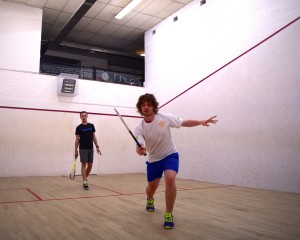
DSC_0043

Being ‘front-on’ has numerous advantages. Typically, it is quicker to get into this position but perhaps more pertinently, from this position it is easier to play cross-court shots meaning you can play to the whole court with greater ease than when side-on. With this in mind, it is very difficult for your opponent to anticipate what your shot will be, which will leave them under increased pressure.”

The other major benefit for deception and disguise is that it makes you physically bigger, as we talk about in another blog post ‘Using your body to disguise shots’. By being front on, you are capable of blocking your opponent’s view of the ball, which means they can quite literally lose track of the ball, which is of course a major advantage.

It isn’t all positive though, as the reason players are encouraged to be ‘side-on’ is for improved control. When you are front on, it is often far more difficult to control the ball and keep your shots accurate, particularly when going for a straight shot, so there is some trade-off to playing a shot from a ‘front-on’ position. At times, this trade-off is worth it, especially if you’re short on time or if your opponent plays a weak shot and you can hide the ball from their view but at other times, you can’t beat being side-on.

Have a few goes on it and see when and how being front on at the front works for you!


Filed Under: Disguise, Positional, Tactical, Tips

‘Keep the ball up one shot longer than your opponent’


A Primitive playing style but sometimes that last ditch shot is the winning one. 

I didn’t like the phrase when I first heard it and I still think it’s a rather crude and primitive way of playing the game. I’m not a big fan of attritional squash and I don’t think it’s a long-term way of playing personally but it does have a time and a place.

One of my early coaches imparted this one liner to me and whilst I can be pompous about it, it is undeniably true. No one who has kept the ball up one shot longer than their opponent, at least in the eyes of the marker, has ever lost a rally.

A focus when lacking sharpness 

I was reminded of that line this week as I returned to court for the first time in nearly a month after holiday and found myself making a lot of poor decisions and not hitting my target areas of the court. Despite a poor first game riddled with errors and sloppy movement, I decided that it would be better to keep going and practice my aggressive play, as I judged it would just take me time to get sharp again and I should play through it, which is a fair argument. It didn’t stop me from losing the match soundly that day though or the next day as I was beaten again in similar circumstances. Without much court time behind me, I just wasn’t finding the touch or accuracy I needed with any of my short shots or length on a consistent basis.

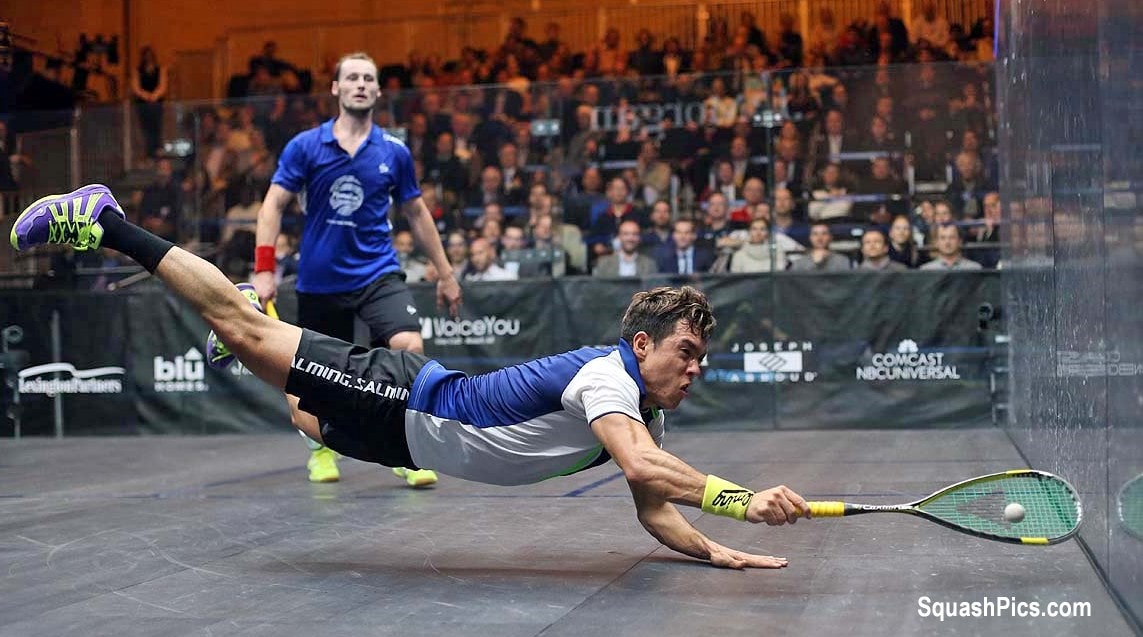
It’s amazing how many times you retrieve a good shot by just getting your racket on the ball or with a loose shot at full stretch, which  your opponent should put away, but instead they hit the ball in the tin because they got sloppy thinking they’d won the rally.”

It wasn’t too much of a problem, as it was just a training game after all. However, thinking more pragmatically, in order to improve my chances of winning the game, I should have adopted a more pragmatic approach and focused on keeping the ball alive. I just wasn’t sharp enough to get in the proper positions necessary to attack effectively, which meant I essentially forcing my shots and naturally made a lot of unforced errors. Cutting out the errors, I might well have won the match.

Secondly, if I’d kept the ball up more, I would have had more shots in general during the rallies, which would’ve also been significantly longer. The more shots I had, the more practice I would’ve got and the sharper I would’ve been from the practice. After all, the best practice is the practice that provides you with the most chances to hit the ball. With a few more shots under my belt, I might well have found myself starting to find my range and accuracy a bit more.

SH13068-min

Everyone has got to have that steel about them no matter how skilful a player they are and there are always times when you simply need to keep the ball up and keeping that ball up just once more can often prove the difference.

It’s amazing how many times you retrieve a good shot by just getting your racket on the ball or with a loose shot at full stretch, which  your opponent should put away, but instead they hit the ball in the tin because they got sloppy thinking they’d won the rally.

Sometimes, you just need to keep that ball up one shot longer than your opponent.


Filed Under: Physical, Tactical, Tips

Let your hand go beyond the ball


Is the follow through replacing backswing?

In this post, I will discuss a small technical point which I believe can improve almost all shots for players of all abilities in squash, which does sound like a bold statement to make.

When you strike the ball, check whether your hand goes beyond the ball. If your follow through is really long enough, your hand should go beyond where the contact with the ball took place. If the ball had co-ordinates in time and space, your hand would need to go beyond this point.

If you make this subtle yet significant change to your follow through, you should notice significant improvement in your ball control, particularly when playing from the back of the court, although I have also found it very useful while volleying and playing touch shots, such as the drop and drop volley, as well.

There is always time to follow through a shot though and so the follow through is almost consuming the backswing in the modern game.”

One professional player who does this particularly well is Mohamed El Shorbagy. At times, his backswing is nearly non-existent. His follow through though is phenomenal and allows him to get superb power and control.

Greater emphasis on the follow through is something that seems to be happening at the top level of the game and is something that can also be applied at club level. With the game becoming faster and faster, there simply isn’t the same time to prepare the racket and get a perfect backswing.

There is always time to follow through a shot though and so the follow through is almost consuming the backswing in the modern game.

Once you get comfortable with letting your hand go beyond the ball more (and if you get any improvement!), see if you can begin to hit your shots quicker by replacing some of your backswing with this extended follow through. After a bit of practice, it will allow you to execute your shots quicker which is exactly what you need for taking the ball earlier. With this extended follow through, you can move higher up the court and hit the ball higher up the court, thereby applying more pressure to your opponent by reducing the time between your shots and increasing the pace of the game.

Try it out! It’s such a small change but one that can revolutionise your game and ball control.


Filed Under: Technical, Tips Tagged With: advanced squash tips, backswing, basic squash tips, follow-through

Keeping hydrated when playing squash


Are poor hydration levels impacting your performance?

Hydration impacts significantly on sporting performance. Lots of people skip the subject saying they ‘don’t drink water’ or they ‘don’t need to drink’ and many players will go through matches without having anything more than a sip of water from a water fountain. Whether or not your realise it, it has a huge impact on your performance, especially in the latter stages. If you start hydrating yourself properly, you’ll be amazed at just how much your physical and mental performance can improve.

One very important thing that a lot of people don’t realise is that once you feel thirsty, it’s already too late. Feeling thirsty is a sign of the onset of dehydration, albeit not at a serious level which will affect your health, but at a level significant enough to impact your performance. If you feel thirsty, your concentration and physical performance will already be suffering.

Pre-Game

Before a game, it’s important to start making sure you’re well hydrated in advance. To achieve optimal performance, you need to start preparing 2 to 3 hours before that match.

The drinking during this time should be in gradual doses and you should look to consume around 400-500ml of water. This sounds like a lot but isn’t all that much when spread out across 3 hours, particularly if you are about to embark on an intense match. Just make sure you’re close to the toilet in the lead up to a match!

As well as getting in a habit of drinking sufficiently, it’s also important to take steps pre-match towards aiding your concentration and getting in the zone.

Try having a 500ml bottle with you before you play a match which you can swig from. It’s a small and easy thing to do which will make a lot of difference to your quality of performance. If you’re really serious keep a 1l bottle with you at all times!

In-Game

You only need glance down at your shirt to see how much water you’ve lost during a match. This water must be replenished. Ideally, you’ll be able to drink smaller amounts gradually after each game, rather than necking a bottle every couple of games or when you feel thirsty.

It is estimated that both the average male and female need to drink just shy of 500ml per 30 minutes of intense exercise and I would class most squash matches as intense exercise. If your match is lasting nearer to an hour, then you’ll need over 900ml of water in order to maintain peak performance, which you don’t need telling is a lot!

This amount will vary of course on how long and intense the rallies are and also will change if you are smaller than the average male or female. You’ll need to drink significantly more if you’re bigger or if you’re playing high-level matches.. These are all rather generic figures though, as some people will sweat more than others or need more water irrespective of body size and it also varies depending on several other factors, so use what works for you. What is clear though is you need to drink a lot.

I’d recommend getting a 1 litre sports bottle right away and keeping it close by during matches.

Are electrolytes real? Is Lucozade Sport really better than water?

You might be surprised (or not surprised) to find that water isn’t actually enough on its own to rehydrate properly during and after intense exercise, as you lose lots of different minerals in sweat and during exercise. ‘Electrolytes’ is a term generally used to describe potassium and sodium, amongst a few other things.

Lucozade isn’t better than water, as their slogan suggests but it does have some important properties that water lacks, although it is no good on its own and not great in pure form.

Sports drinks are important for replacing the electrolytes which your muscles will need to function but most of them contain so much sugar that they will detract vital bodily energies away from the muscles. You need sufficient amounts of these electrolytes so that the Sodium-Potassium pumps in the cell membranes of your muscles can make your muscles contract effectively. These pumps rely on keeping a higher concentration of potassium outside the cell and sodium inside the cells to make muscles contract. During the more intense rallies, potassium can move out of the cells so rapidly that there isn’t a high enough concentration in the cell to maintain balance and the muscles gradually contract with less and less power until you’re fatigued.

You need to be able to replenish the stores of these electrolytes regularly during a match in order to keep your muscles contracting efficiently, which requires a sports drink of some kind. As I just mentioned, sports drinks have too much sugar in them on their own, which is detrimental to your performance. The best way forward is to have a diluted sports drink, i.e. put some water in your Lucozade, which will help you completely rehydrate.

If you don’t replace your fluids properly with a combination of diluted sports drink and water, you will not only find that your performance suffers but also that you’ll get muscle cramps and pains a lot more readily. Being properly hydrated goes a long way in staving off these aches and pains with some research suggesting that lactic acid may not actually be the cause of the muscle ache, but too much potassium building up outside of the cell membranes of muscle cells.

So make sure you bring a diluted sports drink with you alongside your barrel of water!

Post-match

There is a reason a lot of people drink milk based drinks after exercise and that is to help rebuild muscle fibres as well as provide carbohydrates, sodium and calcium, which are all important to recovering physically from exercise. Some of the protein drinks you’ll find will often advertise an excessive amount of protein though. As with all figures it varies a lot depending on your size, gender and a few other things, but generally you only need to take in around 20g of protein and any excess tends not to be processed by the body.

However, having a big glass of milk or healthy milkshake is a good idea to boost your recovery, particularly if you are at a tournament or playing again in a short space of time e.g. within 24-48 hours.

As always, you need to drink plenty of water too.


Filed Under: Mental, Nutrition, Physical, Tips Tagged With: hydration, sports hydration, squash coaching, water

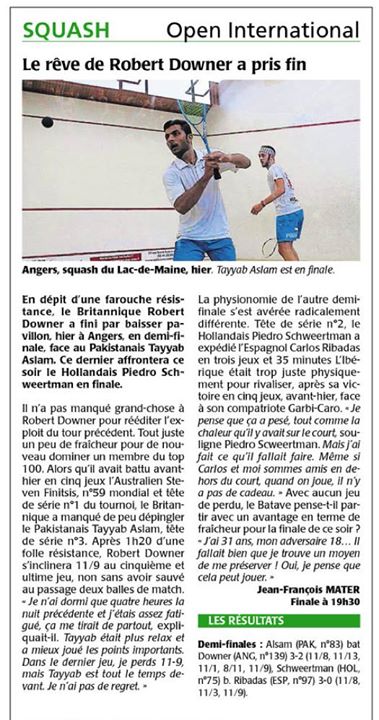
Angers: My defining moment in PSA Squash so far

Robbie discusses his run to the Semi-Finals of the Men’s Open International d’Angers 2015, including his now famous win against first seed and world no.58, Steve Finitsis.

Tournament overview

June 2015 has brought the defining moment of my career so far, in run to the Semi-Finals in the $10,000 International d’Angers. This wasn’t my biggest victory in terms of importance or rankings, but it was certainly a defining moment which has changed a lot.

I arrived in Angers seeded 7th for the event and began with a 12-10, 11-6, 11-6 victory over Scotland’s Jon Geekie. The reward for this win was a quarter-final berth against Steve Finitsis, a good friend of mine who I’ve known for a long while, in what would become probably my biggest result to date.

Steve’s a very fair player so I knew it would be a good contest but I didn’t expect the result! Steve claimed the first 11-7 but I recovered to win the second 11-8. Steve responded emphatically though to win the third 11-4 to claim a 2-1 lead. If it wasn’t for the crowd, who were magnificent and my Spanish amigo, Bernat Jaume, I’m not sure I would have managed to pull it back. With their aid, I triumphed 11-9 in the fourth to set up a decider, which I managed to win 11-7! I never could have anticipated this before hand. I seemed to find better form than him on the day and realising that was a huge moment for me.

I’ve always believed that I can beat players like Steve. Now though, I feel like I will beat them. It’s a subtle but massive shift in mindset. I’ve been told I should now be expecting to win these sort of matches!

After dispatching Steve, I faced Tayyab Aslam, the 3rd seeded Pakistani in the last four. It was difficult regrouping from all that had just happened and unfortunately, I didn’t quite make it happen. Tayyab, the world no. 86, was fresher than me and just had that extra edge when it mattered most, winning 11-9 in the fifth game. It was an 85 minute marathon I couldn’t quite handle after the match against Steve the day before. Despite being disappointed, I was pleased to be able to compete well even when I wasn’t on song.

What made the breakthrough possible?

As with all successes, this victory was the coming together of lots of factors, which all finally clicked in Angers. It was a breakthrough in realising my potential for me. I’ve been working hard on my movement and have also been working through a new training program, which has given me a new lease of self-confidence and a new love for the game, which is incredibly important when you’re training professionally.

I’ve also been developing my tactical skills and become better at what I call ‘mapping out the court’, which means I’m able to navigate my way through matches better, which is taking me away from an erratic and frantic style.

What was the media coverage like?

I got an overwhelming response on social media and from the local media. Doing interviews felt surreal, as did seeing my face in the local paper.Robert Downer French Local Newspaper

The PSA also gave me a mention, which is always nice. I took it in my stride and actually enjoyed it. I just tried to keep my mind calm and focus on the next game, which I’m pleased with given it was a first for me in the senior game.

The media coverage isn’t as intense in squash as other sports and doesn’t really happen to us so much but I do like the way Gregory Gaultier handles the media. In the earlier rounds, he’s often more chatty and relaxed, as there are fewer unexpected defeats in the opening rounds in squash compared with other sports. When he gets to the later rounds though he’s much more serious and eager to get the interview over and done with.

Looking forwards

As I mentioned earlier, some thing has really changed in my mindset. Before, I knew I had the skill and thought I could do well but now I feel I ‘will’ achieve my goals. I compare myself with the top 20 players in the world and how good they were at my age and I don’t think it’s out of reach. The top 20 is the benchmark I’m aiming for, with a view to making the top 10, though this can depend on circumstance. If you look at Nicolas Müller, he was often getting the top seeds in the opening rounds, which stifled his rankings for a long time. Now he’s really breaking into that elite group. Simon Rösner, was always close to the top 10 as well and has recently upped his game and now broken through, edging a lot of closely contested matches.

Angers has made everything real for me. I now believe I will achieve my mission to make the top 20 in the world, and beyond.

You can see some highlights of Robbie’s match versus Steve Finitsus and also follow his progress on:

–Robbie’s Website
–facebook.com/robertdownersquash
–facebook.com/holdandflick

Filed Under: Tips

  • « Previous Page
  • 1
  • …
  • 14
  • 15
  • 16
  • 17
  • 18
  • …
  • 20
  • Next Page »


Terms | Privacy policy | Contact | About us
Web Development By S G Barker.