Squash Company

Squash coaching with passion

  • Squash School
  • Blog
  • Videos
  • Shop

Squash balls explained: what do the dots mean?


What is the difference between squash balls?

Squash balls for senior players come in six varieties, each with different levels of ‘bounce’. The level of bounce is denoted by coloured dots on the ball. For younger players, there are a number of ‘Mini-Squash’ balls available which have a very high, prolonged bounce.

Colour

Bounce

Speed (hang time)

Suggested player level
Orange Super low Super low  High altitude play
Double yellow Slow Very low Experienced squash players
Yellow Slow Low Advanced
Green  Medium/slow Average Advanced
Red Medium High  Beginners
Blue Fast Very high Juniors and new players

* please note: the colours can vary depending on the brand, so make sure you check when purchasing. Also, please feel free to ask us any questions in the comments below. 

The standard ball for professional competitions is the double yellow according to the World Squash Federation. This has been the case since 2001. The bounce of a squash ball also varies as a function of temperature, which is why it is recommended that a squash ball is warmed up before use.

Before 2001, the single yellow dot ball was the competition standard.
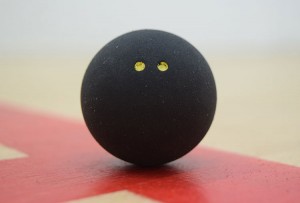
Squash balls - two yellow dots

How to choose a squash ball

The four most common kinds of squash balls are red, blue, single yellow and double yellow. When starting out blue or red balls are best (unless as previously mentioned it is a very young player, in which case ‘Mini-Squash’ balls are preferable, with the orange one being the best). These allow for players who are still developing their hand-eye-coordination to learn techniques without slow reaction times halting progress. Some manufacturers also offer slightly larger balls for new players – for instance the Dunlop ‘Intro’ ball is 12% larger than the standard size, making the ball slower.

Unless you are a good player it is best to play with a blue or red ball while you improve, as more advanced balls require long rallies and regular hard hitting in order to stay sufficiently warm.
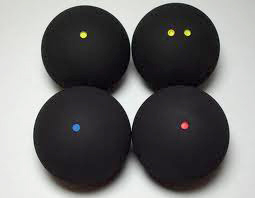
The four most common squash balls

As you get better at squash you can move on to single yellow dot balls, but don’t be tempted to move to double yellow balls immediately. Playing with a more difficult ball prematurely can hinder your performance. Hitting a boast shot for instance, is easier with a single dot ball as the ball sits up a bit higher. Double yellow squash balls are typically used by advanced players.

If you are playing against someone who is at a lowel level than you, play with a ball that is appropriate for his/her skill level.

The temperature of the court should also be taken into account, as some courts are colder than others and you will therefore find it easier to play with bouncier balls. In the winter on colder courts, we frequently use single dot balls even for advanced players, as the double dot balls simply don’t bounce enough. It often simply makes for a far more enjoyable game to avoid the double dot.

The altitude of a court should also influence your ball choice. In high altitude areas with lower air pressure, it is necessary to use a ball that has even less bounce. A high altitude ‘orange dot ball’ is often used in places such as Mexico City, Johannesburg and Calgary, while a ‘Dunlop green dot’ ball is commonly used in North America.

Using different squash balls in training

There is a bit of egotism in using a double dot ball but there really shouldn’t be at all. It’s a great training exercise to use different balls, especially for advanced players. If you want to focus on volleying, it can be a great exercise to use a much bouncier single dot ball to test an advanced player’s reactions, as the ball will rebound off of the front wall faster. You’d be amazed as well at how difficult it can be to control a very hot single dot or red dot ball when hitting length or short shots. It’s a great ball control exercise to get players seeing if they can still hit dying lengths – length shots which don’t come out of the back corners – with a single or red dot ball. Equally, if you want to work on finishing rallies or hitting better drop shots, use bouncier balls. Anyone can learn to hit a drop shot with a lukewarm double dot ball but can you hit a winning drop – or indeed any winning shot – with a piping hot red dot ball?

Happy playing! If you have any questions or further insights feel free to leave a comment below.

For more information about what equipment to use, we also have detailed guides on rackets and strings. 


Filed Under: Equipment, Tips Tagged With: colored dots, coloured dots, double yellow, single yellow, squash, squash balls

Squash’s favourite tactic: Death by straight drive


It has got my back up again to hear people talking about playing long shots and then more long shots in squash. Playing the ball to the back of the court is a fundamental part of the game and underpins the majority of rallies but on its own, playing only long, hard shots is not a style of squash for the longer term.

I’d go as far as to say drive and length shots are simply a conduit for the more attacking shots in squash. They’re played to create the opportunity to play more attacking shots, such as drops. If my opponent returned one of my drives with a weak shot, I’m sure as hell not going to play another straight drive and hit it straight back to them.

After I’ve played a good length, I’ll be hunting for an opportunity to go short or play an attacking shot, as I don’t want to prolong the rally with endless drives unnecessarily. As soon as the chance comes to go for a more attacking shot, I’ll take it, be it the second shot or the hundredth shot of the rally. You should play a drop or short shot in squash any time you get an opportunity too (although of course you should vary your shots). Otherwise, you’re wasting the advantage you’ve got by getting to the T-Position.

There are times when long length rallies are required; it’s not always easy to force a weak shot from an opponent or perhaps your opponent is simply hitting error after error and keeping the ball in play, and waiting for them to make a mistake is enough. These rallies and games shouldn’t be the norm though.

Yet some people speak about playing drive after drive as if you somehow might eventually bore your opponent to death or overwhelm them with death by drive. It irks me even more when it comes from renowned sources in the game. I’m sure they will disagree with me and they might be right, but as a person who was brought up on length and fitness, I can assure you I’d have been grateful to anyone who taught me how to hit winning shots or even discussed the idea with me! Hitting length after length and running might have been the way once but times have changed. Players need to be able to hit winners and apply pressure from all over the court. Since the introduction of Point-A-Rally, scoring the game has become more aggressive and you need to be able to finish the ball and the straight drive isn’t frequently an outright winner unless it is played with a good deal of deception or hold.

After I’ve played a good length, I’ll be hunting for an opportunity to go short or play an attacking shot, as I don’t want to prolong the rally with endless drives unnecessarily. Otherwise, you’re wasting the advantage you’ve got by getting to the T-Position.”

If you’re in any doubt, I’d ask you to consider what happens whenever a young or inexperienced player starts playing league squash. Quite often they are inexplicably beaten by wily old players with one leg. The younger player is better technically and physically than their opponent, but yet they are beaten. It happens with almost all junior players. Of course it’s because all these experienced players now accept they have no chance to compete physically, so they know they have to win the rallies quickly. So they go short at any opportunity and throw in lots of slower paced shots to keep the pace comfortable for them and to frustrate their opponent. The younger or inexperienced player toils away to get one point, only to watch their opponent rack up three or four in a matter of seconds.

What if as a sport we educated all young and new players in finishing the rally first? What if we taught all of our juniors the little boasts, the different spins, the wristy shots and actively encouraged them?

If we wait until they’re older, it’s a lot harder to integrate into their game. The day comes for everyone when they can no longer get away with fitness and speed and not necessarily because of age. For me, once I started taking on a certain calibre of players, I could no longer outlast them as they were also fit. I also didn’t have the shots to hurt them, so I was in trouble!

Playing only length might be a good game plan against certain players but it’s not a style of play for the long term. Make sure you practice finishing rallies!


Filed Under: Drives, Mental, Tactical, Tips

Getting your racket above the ball


Making shots take on more of a downward angle to make them more effective.

One thing you can do to make even the most ordinary shots more attacking is to get your racket above the ball. If your hit your shots from this position, the ball will go downwards and put far more pressure on your opponent, as they’ll know the ball is going to bounce twice fairly soon. This is something you should particularly look to do when you’re playing straight drives or lengths shots. It’s easy to get into a habit of hitting aimlessly down the line without really paying attention to the accuracy of your width and length but if you get your racket above the ball, you’ll make your ball die or bounce twice quicker.

The aim with playing this straight drive with the racket above the ball is to make the ball bounce twice in the back corner and not come off the back wall. If you do this repeatedly over the course of a game, your opponent will be under enormous pressure in every sense of the word.

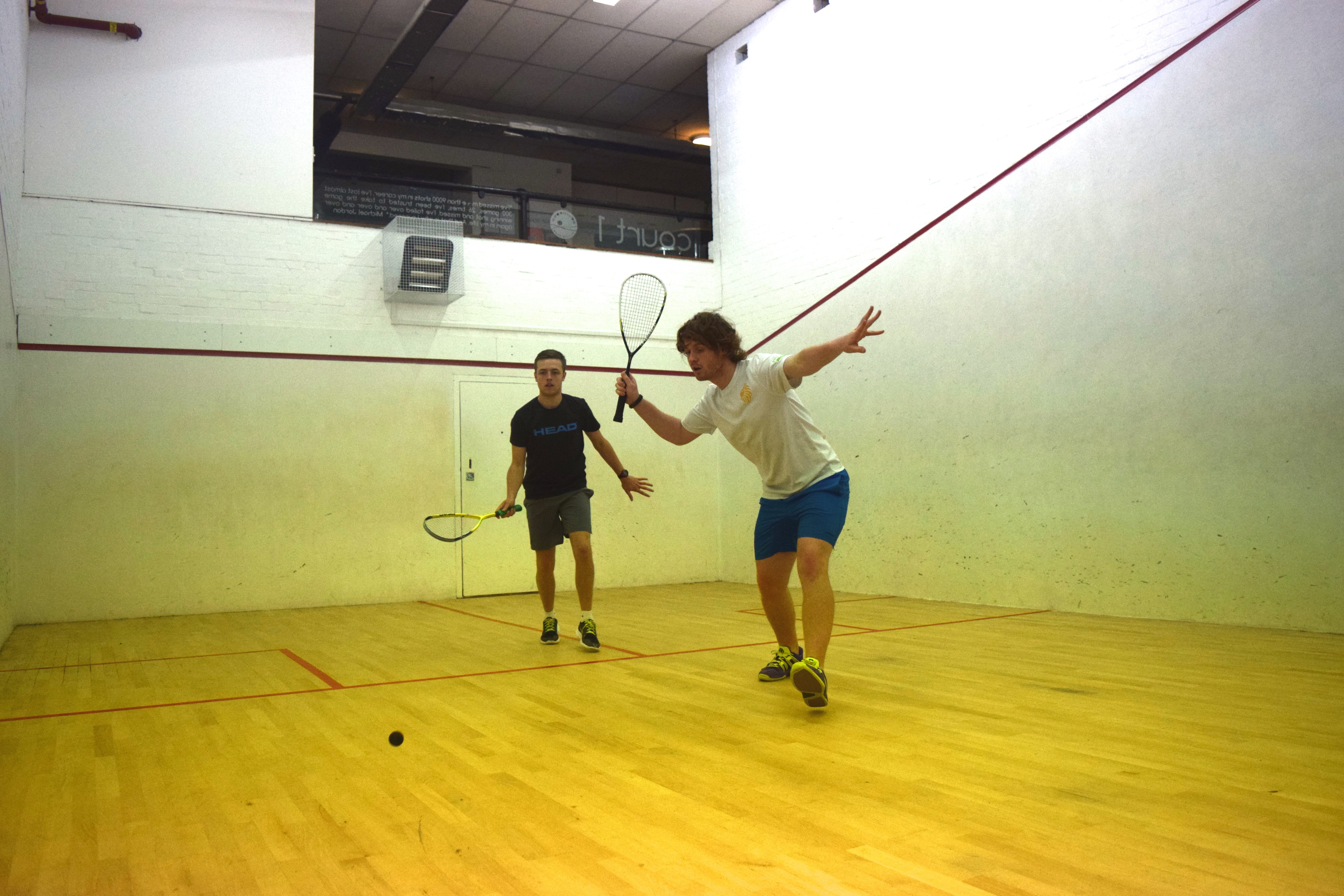
DSC_0075-min

Physically, they’ll have to move quicker to get the ball and if they get there, they will most likely not be in the greatest position. Psychologically, they’ll have to select their shot while rushing, which is never easy. Assuming that either psychologically or physically they come up even a bit short, their technique and shot itself will also suffer.

This simple change in racket height when you begin your backswing can do all that. It just goes to show that playing attacking squash and winning points isn’t about hitting nicks or winning shots but about applying pressure through small alterations to even the simplest of shots.


Filed Under: Technical, Tips

The return of the three wall boast


As I talked about in a previous post, the traditional three-wall boast has been falling out of favour in modern squash, making way for a vicious two-wall boast, which bounces twice before the third side wall and is tricky to retrieve. However, the three-wall boast is now experiencing something of a renaissance in the professional game in a different guise.

Players are still trying to avoid hitting defensive three wall boasts but they are now using the three wall boast as a jarring, time-buying abomination of a shot. Rather than meekly hitting a defensive boast when in a bad position, players are now drilling the boast as hard and high as they can. 

They’re not trying to play a trick shot or attempt a skid-boast (a high fast boast where the ball is played from one back corner of the court with the aim of landing it in the opposite back corner) though but at the same angle they would use for a traditional defensive boast.

The effect it has is that it drives the opponent back. It’s such a headache to deal with coming in hard and high and straight to the middle of the court. Players are usually taken aback by the shot and unsure of how to deal with it, often leading to a weak shot or bad shot choice. Not only does it buy the perpetrator of the shot time but it commonly puts them on the offensive as the other person is shocked.

It’s important you are able to play different variations of common shots in squash. If you play the same boast every time during a squash match, you’ll find yourself becoming predictable. Alternating between aggressive two wall boasts, more subtle trickle boasts and these jarring, hard three wall boasts will give such variation to your game that an opponent will struggle to gain a foothold against you.

Make sure in your practices and matches that you work on different types of boasts and ways of hitting the shot – you’ll be rewarded for it. Who knows, you might even invent a new way of hitting the boast!

Want to know more about how to play a boast?


Filed Under: Tactical, Technical, Tips

An overview: The Inner Workings of the PSA World Tour

Robbie discusses prize money on the tour and whether it’s possible to get stranded abroad, what it’s like travelling around the circuit and reveals one of his toughest moments of the tour so far in the shower in British Virgin Islands.

Sea, sand and Sun Stroke in British Virgin Islands: One of the toughest moments so far

Playing on the PSA World Tour can be bizarre at times. Extreme too. I played Jamaican Chris Binnie in the Semi-Finals of the British Virgin Islands Open once. It was Caribbean climate at it’s meanest at 37 degrees outside and the courts were certainly not air conditioned. There was a small fan high on the court which just shifted some of the air around. Add to that the fact it was 11am which was the hottest part of the day. Then there was the humidity. They say you should put on an extra 5 degrees for that sort of humidity, meaning it was effectively 42 degrees of Caribbean heat I was dealing with. I had so many changes of kit prepared and my bottle of electrolyte replacement powder ready to come to my aid. I remember during and between each set of the match how I chugged down litres of water and electrolytes, changed shirts, bandanas, wristbands, shorts, the lot. I even changed my socks between games. By the mid-way of each set I could barely stand let alone chase down the ball to gain the next point.

I went 2-1 down in games but managed to build an 8-4 lead in the fourth game. Having done that though, I could not even return the ball properly anymore. Once that was gone, I inevitably lost the match 3-1 within about 5 minutes. Chris adapted to the climate far better than I did which hugely affected the outcome. Following the match I had to be helped to the changing rooms, I couldn’t walk unaided. I stumbled into the shower and just sat there for 20 minutes unable to move, my own body fighting back. I ended up on my back; I had severe shakes and chest cramps, it was my first and thankfully only experience of heat stroke to date. That was certainly a moment I will never forget and I learned a huge amount about how my body functions that day.

Hospitality on the circuit

With three years of experience on the tour under my belt, things have certainly gotten a lot easier with travelling. I’m lucky to say I could pretty much have a place to stay in every country in the world now either through a direct connection or a friend of a friend at least. I seem to often have a great way of meeting the right people at the right time. Once at events it can be hit and miss as to whether or not the organisers pick me up from the airport. I seem to have had huge luck in the past year with the tournaments I entered where I have had really friendly tournament organisers who have made the whole arriving and departing process smooth.

Prize Money: Could you get stranded abroad?

Prize money from events tend to cover between half and all of my travel expenses for the event depending on size of event and how well I do. My dad and I fully fund my squash career through my dad’s business, which along with my appearance fees from league matches, tournament prize money and small amounts of coaching help to cover any costs the prize money doesn’t stretch too. It is a constant battle making ends meet but it is the only way we can continue. There’s no sponsorship available, although I get rackets, strings and kit from various sources which helps. England Squash & Racketball give support to a select few but that’s near impossible to access unless you are head and shoulders above the rest or are coached by one of the national coaches. There is some politics in every sport and squash is certainly no different. So I will be making my own way in squash and in many ways I’m lucky for that because all of the rewards from any success will feel all the sweeter. It also means I’m completely independent and only have people to answer to people who I want to be involved in my journey as a squash professional.

To read more about Robbie’s career to date and his other blog, click here. 

facebook.com/robertdownersquash

facebook.com/holdandflick

Filed Under: Squash news, Tips

  • « Previous Page
  • 1
  • …
  • 15
  • 16
  • 17
  • 18
  • 19
  • 20
  • Next Page »


Terms | Privacy policy | Contact | About us
Web Development By S G Barker.