Squash Company

Squash coaching with passion

  • Squash School
  • Blog
  • Videos
  • Shop

Hitting the nine corners (or 10? Or more?)


Making use of all available space.

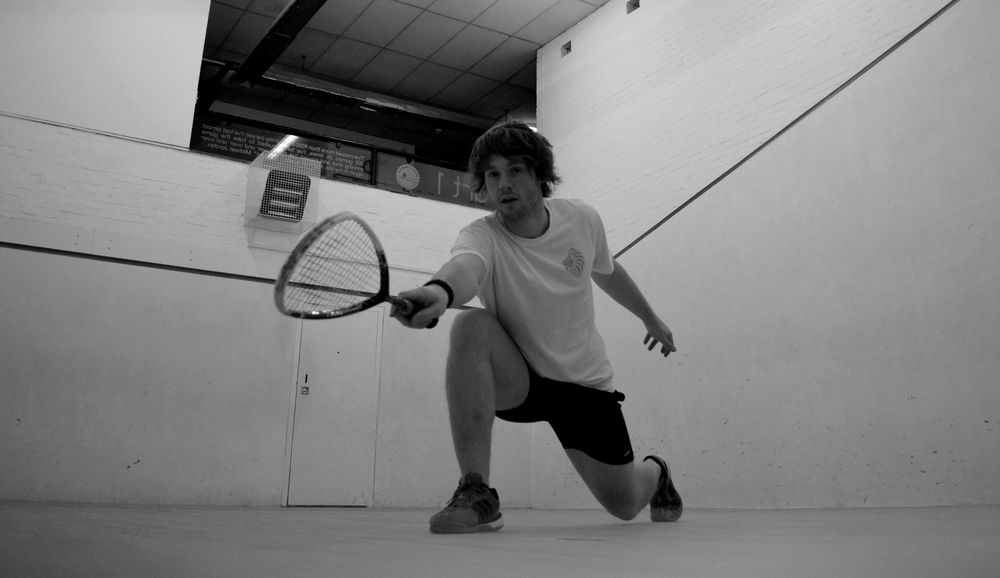
Traditionally, most people think of there being four corners on the court into which we attempt to play the majority of our shots; the two front corners and the two back corners. This can be a very efficient tactic and can even be very exciting when the drops and drop volleys are played to a high level. However, some opponents are fantastic when moving in a straight line but not so good when forced into other areas of the court or when there are lots of cross-court shots. You need to be able to think outside of just these four corners in order to be a well rounded player.

This is a concept Nick Matthew touches upon in his book ‘Sweating Blood’ and it is something which is really important to bear in mind when you are building the rally.

In the anecdote, the idea is presented to Nick Matthew of hitting the ball into ‘eight corners’. Are there eight? Are there more than eight? So where are these eight ‘corners’? These eight are not all ‘corners’ in the traditional sense. There are of course four areas into which you can play effective winners – the four corners we’ve previously mentioned.

In addition to these four traditional corners, when trying to achieve good length, we could play more lob shots, as well as hammering the ball at a low height on the front wall. We could even aim for a middling height at a medium pace. We should also throw in more extremely low shots, such as kill or stun shots. It’s better to have a few different shots that achieve the same goal, such as hitting to length, as this keeps our opponent on the back foot. These varying shots will all hit slightly different areas of the court – the kills and stuns will bounce shorter than a traditional length shot but further back than a drop – which will keep our opponent moving under more pressure as they struggle to keep up with the range of shots played.

Using slightly different shots to force opponents into different areas of the court used will force them away from smooth movement to and from the main four corners, which will almost leave them slightly disorientated.”

You could also play such a wide range of boasts to make better use of the middle areas of the court. The boast could be traditional and hit three walls, coming back off the side wall, or it could be so narrow that it hits the front wall very close to the corner. As I discussed in the post ‘Two-wall or three wall boasts?’, it may also hit the front wall in the middle and therefore bounce twice before the side wall, putting the opponent under pressure.

You can also take a few liberties and play a few shots down the middle in classic Geoff Hunt style! Be careful when you do this though, you’ll need to really sell the deception to avoid giving away strokes.

There are probably several more areas that you can think of and you should try to use as many of them as possible. The court is a rather big place and the walls have humungous surface areas. Ask yourself if you’re really making use of all of the space that is available to you.
Filed Under: Tactical, Tips

Squash Company junior players have something to boast about

The Squash Company’s flagship club Lewes Junior Squash Club, is on the rise. With a county record equaling six teams planned for next season, three juniors representing the County at the national finals and a further four in the County Squad, the club is entering an exciting era.

This month, The Squash Company supplied the finalists for the Dunnings Junior Squash Open Boys U17 Category, with Lewes Junior Champion Cam Baker taking on Will Rowe of Corals Squash Club, who trains weekly at Lewes Squash Club under The Squash Company’s Head Coach Nic Davies. Will marshalled Cam superbly with his drop and volley combinations to take a 2-0 lead before Cam recovered with a spectacular run of shots, boasts and angle shots to take the third 11-4. Will reestablished his control in the fourth though and displayed great assurance and concentration to close out the fourth to win 3-1 and take the title.

Meanwhile, another Squash Company protegee Emily Kimber was invited to participate in the Tecnifibre English Junior Open in the Girls U15 category. Only the very best players in each age group are allowed to participate, so being part of the event itself a great feat. Although she fell to a 3-0 defeat in the first round to a highly seeded player, it was a great experience and achievement for Emily, particularly as she still has another year to go in the age range.

We’re very proud of all of you for your hard work and achievements!

Filed Under: Squash news, Tips

Topspin Drops


A very brief post just to highlight the number of professional squash players now frequently playing topspin drops from the front of the court.

back corner shots squash

It is most commonly used when the ball is glued to the side wall, making it very difficult to return under any circumstances.

In this situation, hitting the racket’s sweet spot becomes near impossible so the use of topspin can give a greater element of control and also give the ball the impetus to make the front wall.”

When played successfully, it also comes back deadly tight to the side wall. Try it out!


Filed Under: Drops, Technical, Tips

Using your body to hide shots in Squash


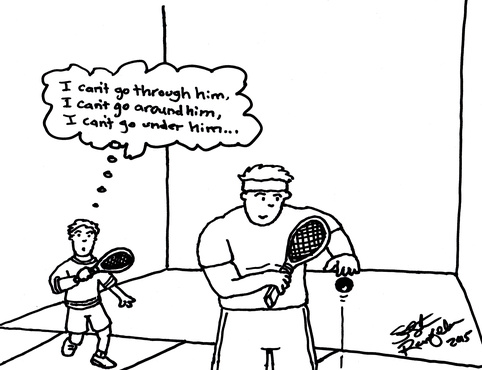
We’ve all played squash against one of those big guys. They stand on the T-Position and are almost impossible to dislodge. Any attempt and you seem to bounce off them towards the back corners.

You could cope with that though. That would be bearable if it wasn’t for the fact they obscure your vision of the ball with their body so that you can’t actually see the ball as they are about to play their shot. It might be a little morally grey but is there a better disguise? Imagine your opponent not actually being able to see the ball or your hand in your shots first moments.

This would leave them well off the pace and lagging behind. If there is no way of seeing the ball, it’s almost impossible to anticipate what will happen next.

How to use your body for deception

Try playing a ball from the front whilst ‘front on’ – facing the front wall with your body rather than the side wall as is traditional for most squash shots. This will make you bigger and obscure your opponents vision slightly. It can be challenging to maintain ball control from this position but it opens up a plethora of options. It requires dexterity as you will usually have to play the ball quite close to your body, so you may need to use a your wrist from this position.

“It might be a little morally grey but is there a better disguise? Imagine your opponent not actually being able to see the ball or your hand in your shots first moments.”

Quite often the ball will be flying past your opponent before they are even able to move. Immoral? Just a touch perhaps, but boy is it effective! Give it a try and see what you think!


Filed Under: Disguise, Tactical, Tips

The Importance of lobbing


Squash’s unsung shot?

I’m on a crusade. A lob shot crusade. The purpose of this post is simply to raise awareness of the lobbing and to encourage you to do it more!

Why? It is a neglected shot, particularly at junior and club level. Judging the right height and width to avoid your opponents volley is tough at first but this is often due to a lack of practice. We simply don’t play the lob as often as we ought to, resorting to whack the ball to length frequently because we lack the composure to slow ourselves enough to play a lob or simply not trusting in our ball control.

The Advantages

In many ways this rarity is to your advantage though. As they are uncommon, players are often ill-prepared to deal with lob shots. Make them your secret weapon. If it’s played well, the lob is often an outright winner as it can just dribble into the back corners leaving opponents with no room to swing and a ball with no momentum. Even a wild swipe won’t save someone from a well executed lob shot.

The Importance of lobbing
Do you lob enough? Do you even lob?

Additionally the lob is a great counter-attacking shot, a bit like the two wall boast I’ve talked about before, and can help you go from chasing the rally to being in control in just one shot. The cross-court lob from the back of the court can be challenging to judge but it is such a good shot for catching an opponent out, as is the straight lob from the front, a favourite of mine.

Lob shots slow the pace of the match and can be particularly effective against players who like to hit the ball hard and run a lot, as they will disrupt the faster pace they enjoy and ruin their rhythm. This strategy of changing the pace is something you should be able to do if you have aspirations in the game, as it is the sort of tactic that can change the course of a game. Lobs are also useful against smaller players, which is particularly poignant at junior level. Although, they are also effective against tall players, where a drop and lob game can make the tallest player exhausted from lunging down and then standing up high repeatedly!

When you practice lobbing, really go for the height. Forget all else – just ensure you get the lift. From there you can learn to control the angle and the pace.

Next time you play, just see if you play a single lob shot. If you don’t or only play a lob rarely, your game is missing a vital dimension.


Filed Under: Tactical, Technical, Tips

  • « Previous Page
  • 1
  • …
  • 17
  • 18
  • 19
  • 20
  • Next Page »


Terms | Privacy policy | Contact | About us
Web Development By S G Barker.