Squash Company

Squash coaching with passion

  • Squash School
  • Blog
  • Videos
  • Shop

The rise of the two wall boast


In squash, when you think of a boast you tend to conjure up an image of a shot hitting three walls; the side wall you’ve hit the ball into, the front wall and then the side wall on the far side. This boast is a fairly defensive shot and in many ways fairly limited shot, as it often sits up quite nicely for the opponent to attack.

At the top level, three wall boasts are becoming few and far between. They are something of a last ditch shot on the majority of occasions with almost all boasts now being played with the aim of bouncing twice before the far side wall, making them only two wall boasts.

The reason the two wall boast is becoming so prominent is because it can put immense pressure on your opponent.
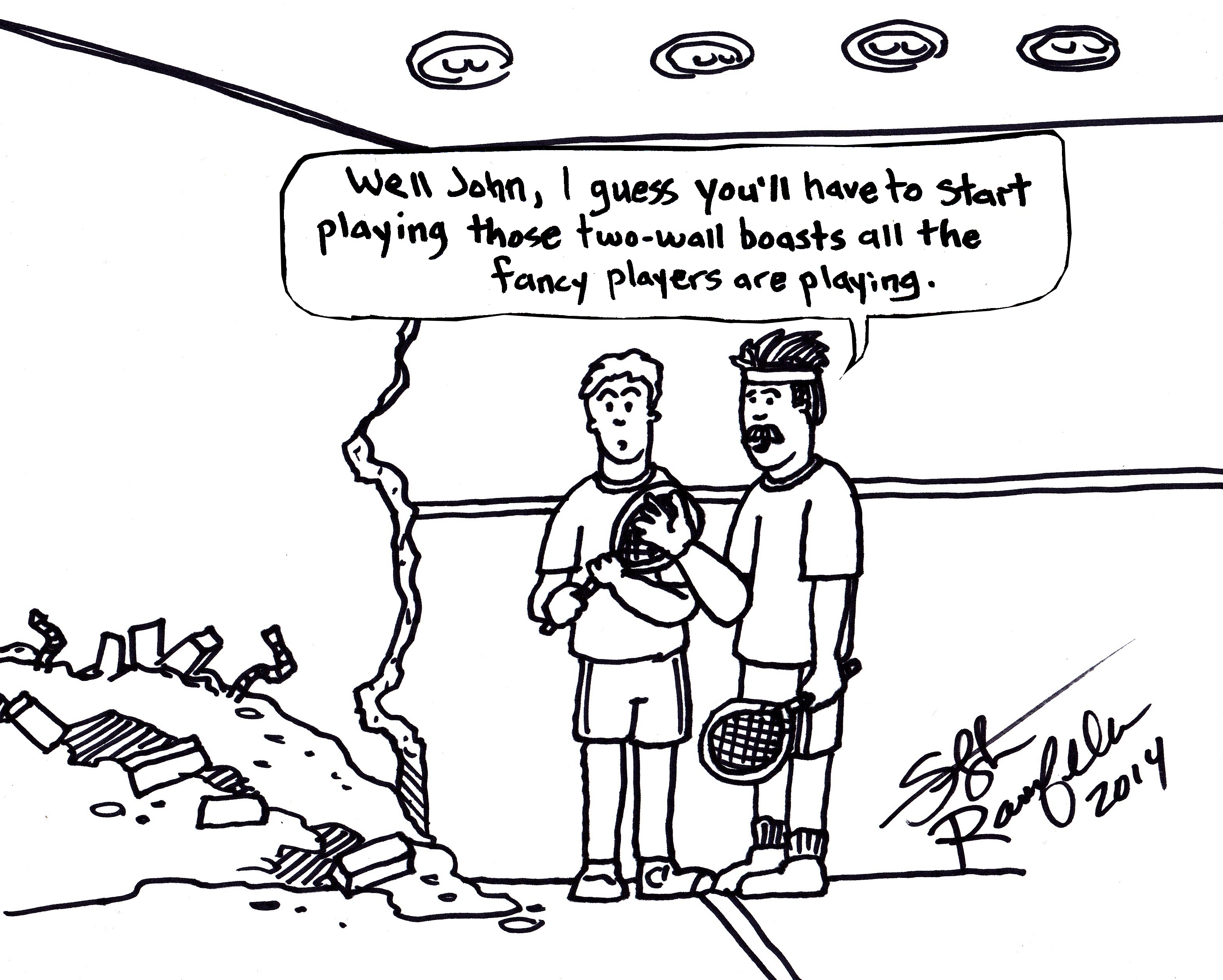
two or three wall boasts

If a two wall boast is played correctly (this is not always easy), the ball will hit the middle of the front wall and bounce twice before the far side wall, meaning your opponent will have to lunge down low to recover the ball, which will require significant speed and energy and leave them awkwardly placed.

Not that the three wall boast’s obituary should be written just yet – it can be better to play a three wall boast than attempt a weak length shot from a tight position in the corner and it can give you time if you are in trouble. A few are even playing the three wall boast at an incredible pace to make it bounce back to the middle so it is more awkward for the opponent, which we talk about in another blog post.

What makes the two wall boast an effective weapon is that you can be in a bad position at the back of the court and still have the opportunity to play it. In just one shot, you can go from being under pressure to being the player on top.

It’s a fantastic combination shot and if your opponent is deep and not covering the T properly or has started to drift towards one side of the court expecting a straight drive,  it can be a useful winning shot to have up your sleeve.

If played correctly (this is not always easy), the ball will hit the middle of the front wall and bounce twice before the far side wall, meaning your opponent will have to lunge down low to recover the ball, which will require significant speed and energy and leave them awkwardly placed.”

It’s also a shot you can experiment with and vary. A two wall boast can be played soft like a drop or fizzed in hard and low and can also be played at an angle so narrow that is stays on the same side as which it was hit.

Lastly, it is also useful as a combo shot as more often than not players will respond to a two wall boast by going to length with the next shot, often a cross-court lob, leaving you with a volley opportunity.

Try it and see if you can catch your opponent cold with a few two wall boasts.



Filed Under: Boasts, Tactical, Technical, Tips Tagged With: boast, boast shot, three wall boast, two wall boast

The Squash Evolutionary Race


Constant Evolution

You can think of a squash match as being a bit like a Darwinian squash evolutionary race. It is almost akin to the race between humans and bacteria. Humans use a Antibiotic A, the bacteria is badly beaten but eventually emerges stronger and immune to Antibiotic A, so the scientists bring out Antibiotic B.

In squash, you are constantly aiming to stay one foot ahead of your opponent just as humans look to stay ahead of the constantly adapting bacteria.

If you play a lot of drop shots – watch how your opponent will start to move higher up the court before your shot, anticipating your next drop. If you hit it hard, harder and then harder still, watch how your opponent sinks back deeper on the court, below the T-Position expecting your next drive, making them vulnerable to a vicious two-wall boast. You need your game to be constantly evolving during a match to stay on top.

The-Squash-Evolutionary-Race

What you need to do is always try and stay one step ahead of your opponent. Once they start dropping deep after your onslaught of lengths, go for a quick boast or a long drop. That will catch them out and them leave them unsure of your next move again.

If you’ve played a lot of drops from the forehand front corner, go through a stage of playing more cross-court lengths from the same position. Again, they will be caught out. Much like the bacteria though, your opponent will eventually adapt and evolve again and look for a cross-court drive from the forehand front corner.

If you play a lot of drop shots – watch how your opponent will start to move higher up the court before your shot, anticipating your next drop. If you hit it hard, harder and then harder still, watch how your opponent sinks back deeper on the court, below the T-Position expecting your next drive, making them vulnerable to a vicious two-wall boast. You need your game to be constantly evolving during a match to stay on top.”

My advice for you is to make sure that you mix up your game frequently and keep evolving. This is not to say every single shot should be played to a different corner – that is unlikely to create sustained pressure (although playing a game like that is a worthwhile exercise*). You might just alternate between a drop and a drive from the forehand front corner (though I would recommend a little more variation!). What it does mean though is that once you have had success with a particular tactic or shot, you need to be ready to change that before your opponent gets in rhythm with it too easily. As with many things, you need to strengthen while you are ahead. You need to sense that point when your opponent starts to predict that cheeky boast you’ve been playing and swap it for a straight shot. Make your opponent think they are on to you and just as they are catching up, pull the rug out from under their feet by changing your tactics again.

Your Plan A from the forehand front corner might be to play a cross-court drive low and hard. If it is, make sure you have a Plan B and even a Plan C, which might be a straight drop and lob respectively. Whatever your plans, make sure you are able to switch between these plans and to do so at the right time. Eventually, your opponent will adapt to your Plan A no matter how good it is. Even alternating a Plan A and a Plan B again and again can make a real difference.

Make sure you are the one that is ahead in the squash evolutionary race!

*As an exercise, play a match where both players have to play every shot to a different quarter of the court than the last shot they played. Both players could play to the same quarter but an individual’s shot must go to a different quarter than their own last shot. See what patterns of play it creates and how it effects your opponent’s anticipation. It’s also good for making players think about their shot selection.


Filed Under: Tactical, Tips

Changing your grip and racket face for different shots in Squash


Have you ever tried changing the grip for different shots? Or changed the way you hold your racket during a rally to aid a particular shot? Or played with the angle of the racket face from the default stance of ‘open’? Perhaps you’ve gripped your racket higher up the handle when the ball was in the back corners of the court in order to give you more control and leverage for digging a dying ball out of the back. Or maybe you’ve opened your grip up to further open the racket face when going for a drop shot.

Amr Shabana, the Four-Time World Open Champion, does this to great effect. He frequently slides his hand up and down his racket, changing the grip depending on the shot he is playing.

As a general rule of thumb, the lower you hold the racket on the handle, the more power you get. The higher you hold it, the more control. This is why it is almost universally recommended that you grip the handle somewhere in the middle, so that you can achieve both.

There are certainly shots and situations where changing your grip can help though, such as in the aforementioned example of being in the back corner. Holding the racket a little higher allows you to get more control on the ball and not only stay in a rally but stay in it with interest.

Changing your grip and racket face for different shots

As a general rule of thumb, the lower you hold the racket on the handle, the more power you get. The higher you hold it, the more control. This is why it is almost universally recommended that you grip the handle somewhere in the middle, so that you can achieve both.”

It can also help to shift the grip so that the face is more open from the back, giving you a bit more bite from the back.

If you’re feeling particularly bold, try closing your racket face for particularly aggressive drives or kills, as this has the effect of keeping the ball very low. You can also try to do this  when going for an aggressive boast, which can make the ball flatline and die.

It might feel a little clumsy at first but it’s something you should experiment with as it can really make all the difference in challenging situations.

For more information on how you should be holding your racket, visit our page on the grip here. 


Filed Under: Grip, Technical, Tips

PSA Squash Blogger: Introducing Robert Downer

“Hi I’m Robert Downer. I’m 22 and I am a Hampshire based Professional Squash Player competing on the Professional Squash Association (PSA) World Tour, as well as a Full-Time student at the University of Winchester where I study Sports Studies with Sports Psychology. With my blog, I’ll be giving you an insight into my life and my quest to reach the World’s top 20 and beyond and more importantly win PSA Shot of the month at least once, as well as the wacky, wild and at times downright bizarre world of professional squash.”.

I first took up squash when I was 4 years of age when my dad introduced me to the sport, having taking it up the year before. He was set on keeping me away from football and he really encouraged my interest in squash. His external motivation wasn’t required for a lengthy period though as I became forever hungry to be on that squash court, a hunger that has carried me right the way through my junior career and beyond. I honestly believe I’ll play on the tour until my body has had enough, as my mind will never say; ‘that’s enough’.

I currently move between my home town of Portsmouth, my university base of Winchester and Lee On The Solent where I train with a group of Pro’s including Oliver Pett and Steve Wykes under the guidance of my coach Tim Vail. The travelling does make it tough to fit everything in.

Combining professional squash and education is something I never imagined myself doing and a challenge which is testing my mental limits! The University of Winchester have been fantastic though and given me a full scholarship in partnership with Winchester Racquets and Fitness Club in return for me promoting squash and the university. Not a bad deal all round with the prices of Student Loans in England now but it can be difficult combining my studies with my training and a tournament schedule which sees me compete in over 10 International PSA events and several UK Based ones a year.

I exploded a few times in my first semester of university, as I was just not finding time to train. I really didn’t understand how to manage my time efficiently. I have that disease known as  procrastination and I struggle to motivate myself to get on with work unless I can see the deadline looming, which is certainly something I am working on, as I’ve had to put down the racquet for a week before due to the studies building up too much. I spend lots of my life studying on planes, trains, buses and sometimes even the beaches of Dubai!

Career so far

As a junior I won six Hampshire Junior County Championships across all five age categories and was Senior Champion at 16. I also reached number 1 in England at U17 level, before reaching number 1 in Europe at under 19 level. Perhaps my greatest achievement though was reaching the final of the U19 British Junior National Championships, where I toppled number 2 seed and current World No. 67 Charles Sharpes in the semi-final. I may have lost out in a close 3-0 to top seed Ben Coleman in the final but that the semi-final win over Charles meant the world to me. I was an emotional wreck the night before playing Ben due to the disbelief that I had actually beaten Charles. It had been six years since the previous win!

During that season I won the Senior County Championships, I also made it into the top 8 in U17 European rankings which gave me free PSA World Tour membership for the next season, which lead me to entering my first PSA tournament, the Meersquash Heroes Open in The Netherlands. I snuck in a week before the tournament was to due be played and so hurriedly booked my flights and arranged to crash on a friend of mine’s sofa in the heart of Amsterdam. Not only was I unseeded, I also had to play a round of qualification as I was the lowest ranked player on the entire PSA Rankings, which I guess made me officially the worst player in the world. However, I shocked everyone including myself by taking out 4th seed Phil Nightingale and 6th seed Bastiaan Meulenbelt, before edging out Northamptonshire’s Mark Fuller in the Semi-Final. That match was one of the most gruelling matches of my career so far, as I came through 12-10 in the fifth after I had saved a match ball at 10-9 down in that fifth game with an incredible 4 minute rally that even the referee noted. It meant the world to me and also made me eligible for the prize of facing Top seeded Dutchman Piedro Schweertman in the final – on the same day! I lost 3-1 but that tournament still remains my first and only PSA final appearance to date, though I’ve made three Semi-Finals.

Just recently I gained entry into the Dubai Squash Cup ($25K) in November 2014 which will be the largest event I have not had to qualify for so far in my career, which is a nice sign of my progress on the PSA Tour.

Rob will continue to blog for The Squash Company on a regular basis.

You can also follow Robert on his Facebook accounts:

Robert Downer Squash

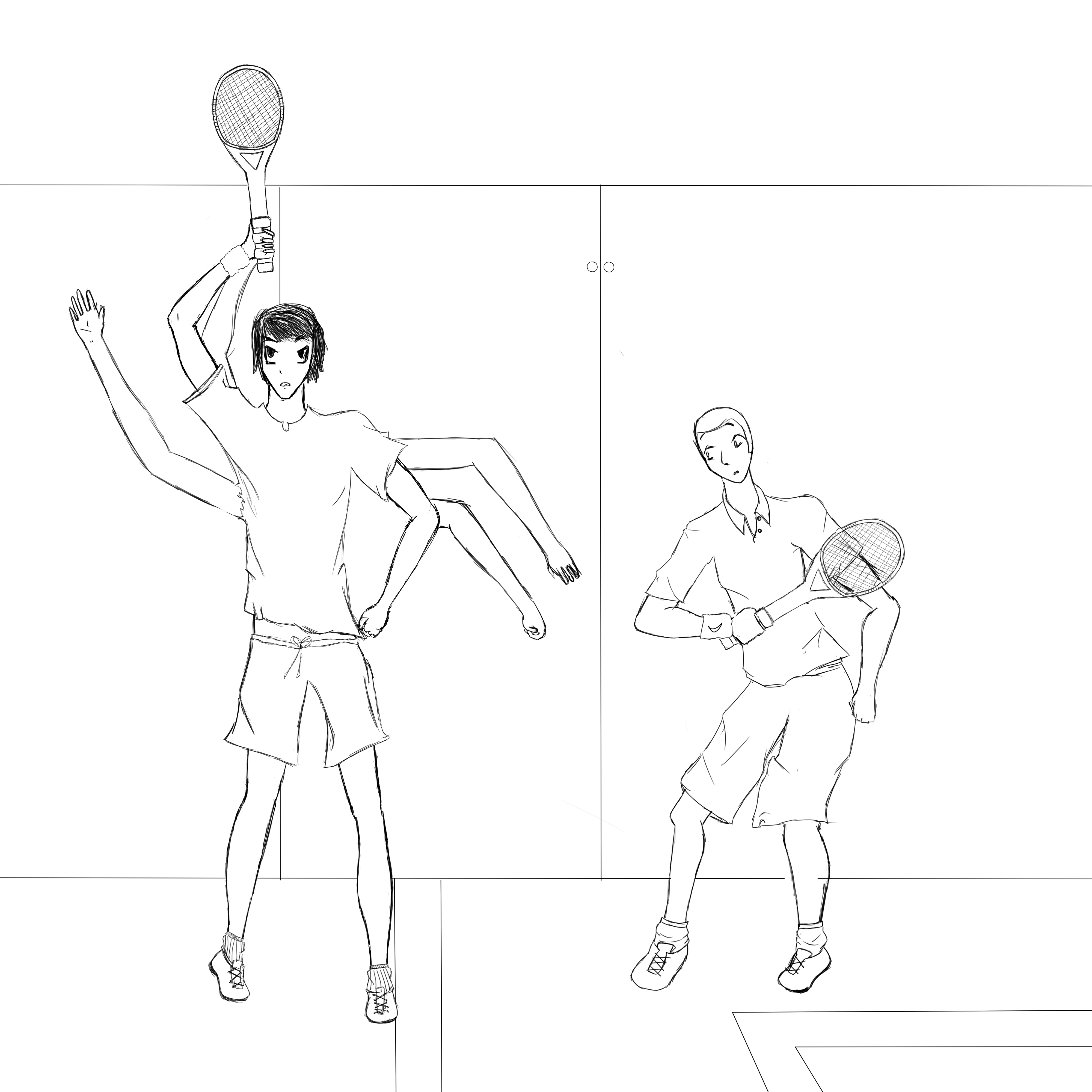
Hold and flick

Filed Under: Tips

Squash: Watching the ball using your ‘Radar Eye’


Watching the ball is incredibly important in squash but not always as simple as it sounds. Do you ever feel like you just don’t see the ball as early on one side of the court? Is your Volley stronger on one side than the other? It may be to do with your eyes!

The idea of the ‘Radar Eye’ has to be one of my favourite coaching discoveries of 2013/2014 and was shared with me by England Squash High Performance Coach Paul Carter.

As many of you may be aware, the vast majority of people have a preference for one eye or the other; one eye is dominant. In most cases, it is the right eye which is the stronger one, although a significant number of people have a dominant left eye and a small number of people have equally proficient eyes. The impact on squash of the dominant eye can be hugely significant as it is responsible for assessing spatial and positional information to a high degree, which of course you need when hitting a small ball at high speed under time constraint.

I used to relish the Backhand Volley and was renowned for my Backhand Drop Volley but never seemed to be able to replicate my success on the Forehand no matter how hard I tried. I lost count of the number of people who said I needed to Volley more on my Forehand. It wasn’t that I was taking it easy on my Forehand or felt less comfortable. If anything, it felt like I just wasn’t in a position to Volley on the Forehand or never quite prepared.

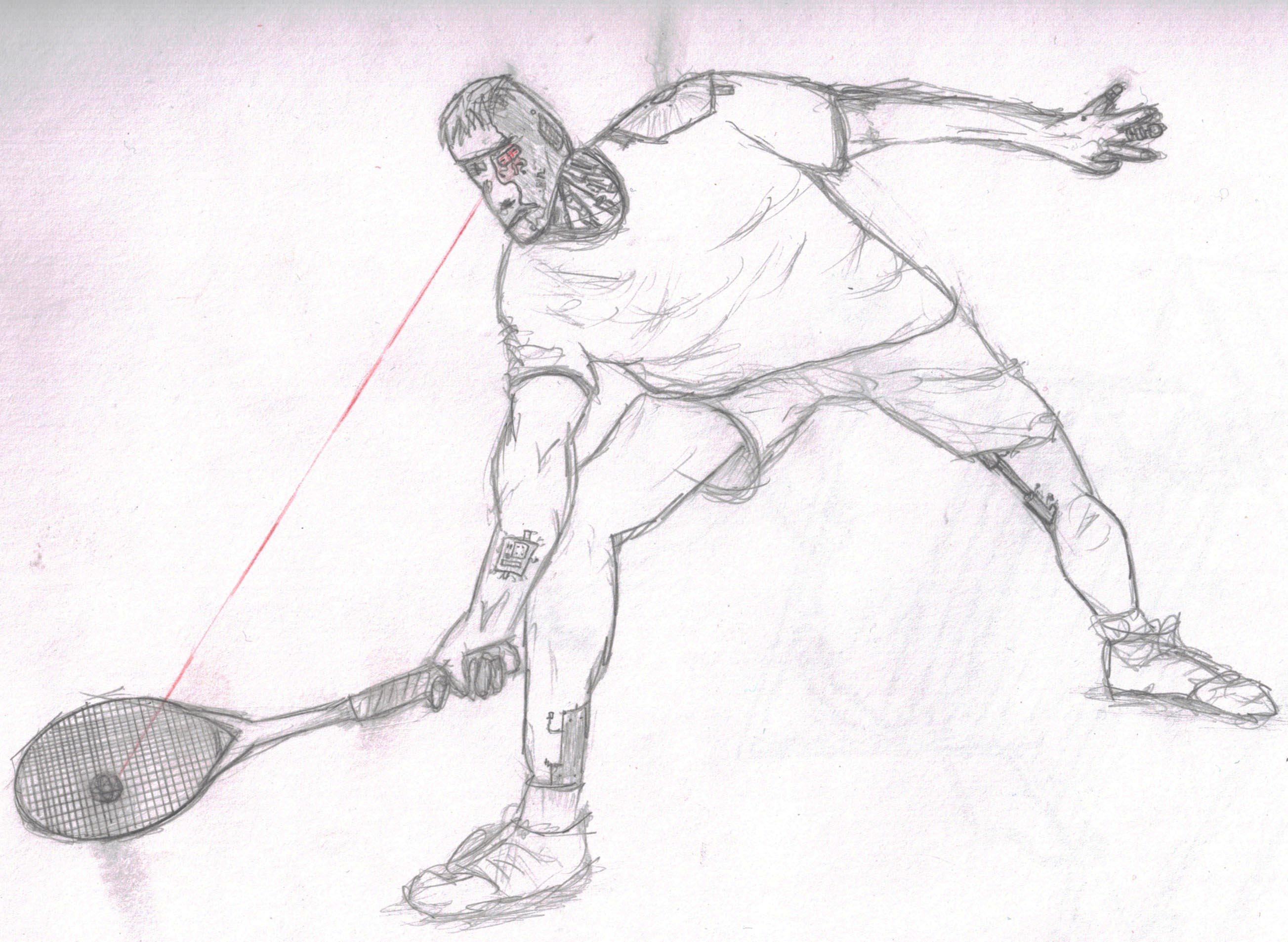
Radar Eye

I used to relish the Backhand Volley and was renowned for my Backhand Drop Volley but never seemed to be able to replicate my success on the Forehand no matter how hard I tried.”

For me, my right eye is dominant by quite some distance and it so happens that on the Backhand my right eye is the one facing forwards, with the left eye in a weaker position and forming my peripheral view, which is all well and good given my right eye is the stronger on. On the Forehand, the opposite was true. My weaker left eye was the one charged with spotting the ball on the forehand and sourcing volley opportunities, while my right eye was wasted in the back. This was enough to ensure I was missing large numbers of opportunities to Volley on the Forehand, which meant I was losing the T-Position and also missing opportunities to increase the pressure on my opponent.

Having a dominant eye is completely normal and not something that can really be fixed and doesn’t need to be in any case! The solution is simple. TURN YOUR HEAD. I have even encouraged some players to take a more open stance, with your body pointed towards the corner, similar to if you were playing a traditional Cross-Court shot, to great effect. This change of positioning allows the dominant eye to become involved in spotting the ball and can be used on both the Forehand or Backhand side depending on which eye is dominant.

This is something I now do myself and it has helped me spot the ball as early as I do on the Backhand and I now have the option to Volley a lot more frequently on my Forehand than before.

If you are not sure you can test which of your eyes is the dominant one using the Dolman Method. Look at a faraway object through a small hole in a piece of paper or similar object using only your left eye. Then repeat the process with the right eye. One of the eyes will usually produce a clearer image and feel easier to focus with, indicating dominance. Of course if both eyes feel fine, you are likely to have co-dominance in your eyes and missing those Volley opportunities may be down to something else!


Filed Under: Tips, Watching the ball

  • « Previous Page
  • 1
  • …
  • 18
  • 19
  • 20


Terms | Privacy policy | Contact | About us
Web Development By S G Barker.