Squash Company

Squash coaching with passion

  • Squash School
  • Blog
  • Videos
  • Shop

London & South East Regional Closed 2016 Draws and schedule

The England Squash London and South East Regional Closed is being held on Saturday 5th November and Sunday 6th November at the K2 Leisure Centre Crawley and Acorns Fitness and Leisure Centre (formerly Copthorne), Gatwick.

Important notes and rules for players are also included at the bottom of the page.


You can find the draws and schedule here:

lse-bu11-draw

lse-bu13-draw

lse-bu15-draw

lse-bu17-draw

lse-bu19-draw

lse-gu11-draw

lse-gu13-draw

lse-gu15-draw

lse-gu17-draw

lse-gu19-draw

official-l-se-regional-court-timetable-2016

Plate and MONRAD Draw sheets:

bu11-monrad-8-draw

bu11-plate-draw

bu13-monrad-8-draw

bu13-plate

bu13-pre-plate

bu15-monrad-8-draw

bu15-plate-draw

bu15-pre-plate-final-draw

bu17-monrad-8-draw

bu17-plate-draw

bu17-pre-plate

bu19-monrad-8-draw

bu19-plate-draw

gu13-monrad-8-draw

gu13-plate-draw

gu15-monrad-8-draw

gu15-plate-draw

gu15-pre-plate-draw

gu17-monrad-8-draw

gu17-plate-draw

Notes and rules

SPLIT VENUES

Please check your schedules carefully as the matches will be split across the K2 Leisure Centre Crawley, Pease Pottage Hill, Crawley RH11 9BQ and Acorns Health & Leisure, Acorn Health & Leisure, Copthorne Road, Copthorne, Crawley, RH10 3SQ,  on Saturday 5th. The two venues are about ten minutes drive apart.

ALL matches being held on Sunday 6th are at the K2 ONLY on.

MONRAD TOP 8

The top eight/quarter finalists of each category will play out the remainder of the event in MONRAD format.

PLATE KNOCK-OUT 

Please pay very close attention to the plate event draws and check those for your category, as it varies from age category to age category. Some categories will also have two separate plate event if there are two rounds before the quarter finals.

All plate matches will be knock-out with the exception of the semi-finals, where there will be a 3rd/4th play-off.

Please not that there are a couple of exception though where plates will be played in a round robin format if there are three players, such as BU17 and BU19.

The Plate trophy will be won by the person who wins the ‘Plate Event’ – not the ‘Pre-Plate’ event or finishes 5th in the MONRAD format.  

GU19 & GU11 will be one-day only

The GU11 will be on SATURDAY only at Acorns and GU19 on SUNDAY only at K2. 

OTHER

All matches are PAR 11, best of 5.

Goggles are mandatory. 

Please arrive at least 30 mins before your appointed time.

Shirts will be available for collection from tournament desks.

Winner marks the next game – please present yourself to tournament desk. Markers may be changed upon discretion of tournament director or an organiser.

Care has been taken, where possible, to ensure siblings do not have matches at the same times at different venues where the draw is known. If this hasn’t been possibly in your case, or the timings are tight or the sitation arises in the latter stages of the tournament, please do your best to plan ahead and ensure your child(ren) arrives on time.

You may notice that there are a few gaps in the schedule on Saturday. I’ve had to leave some gaps for recommended ES rest times and also in case of overrunning but if both players are happy and able to go on earlier, and there is court space, then it may be possible to play matches earlier. If your opponent is not in agreement or it is not this Saturday morning period, please respect the schedule and don’t hassle organisers about timings of games. We all want the tournament to run smoothly and ahead of time but please remember there are over 120 entries and a huge number of matches to play, including some special circumstances.

All times, courts and venues are subject to the discretion of the tournament director.
Filed Under: Tips

Using a very open racket face when you hit cross-courts


Using the side walls to slow your shot down. 

Cross-courts are fantastic attacking shots when played well but it is all too easy to misjudge them and float the ball up for an opponent to attack. When this happens, our opponent is able to intercept the shot and put us under pressure, or even win the rally.

Aiming for a nasty bounce off the side wall 

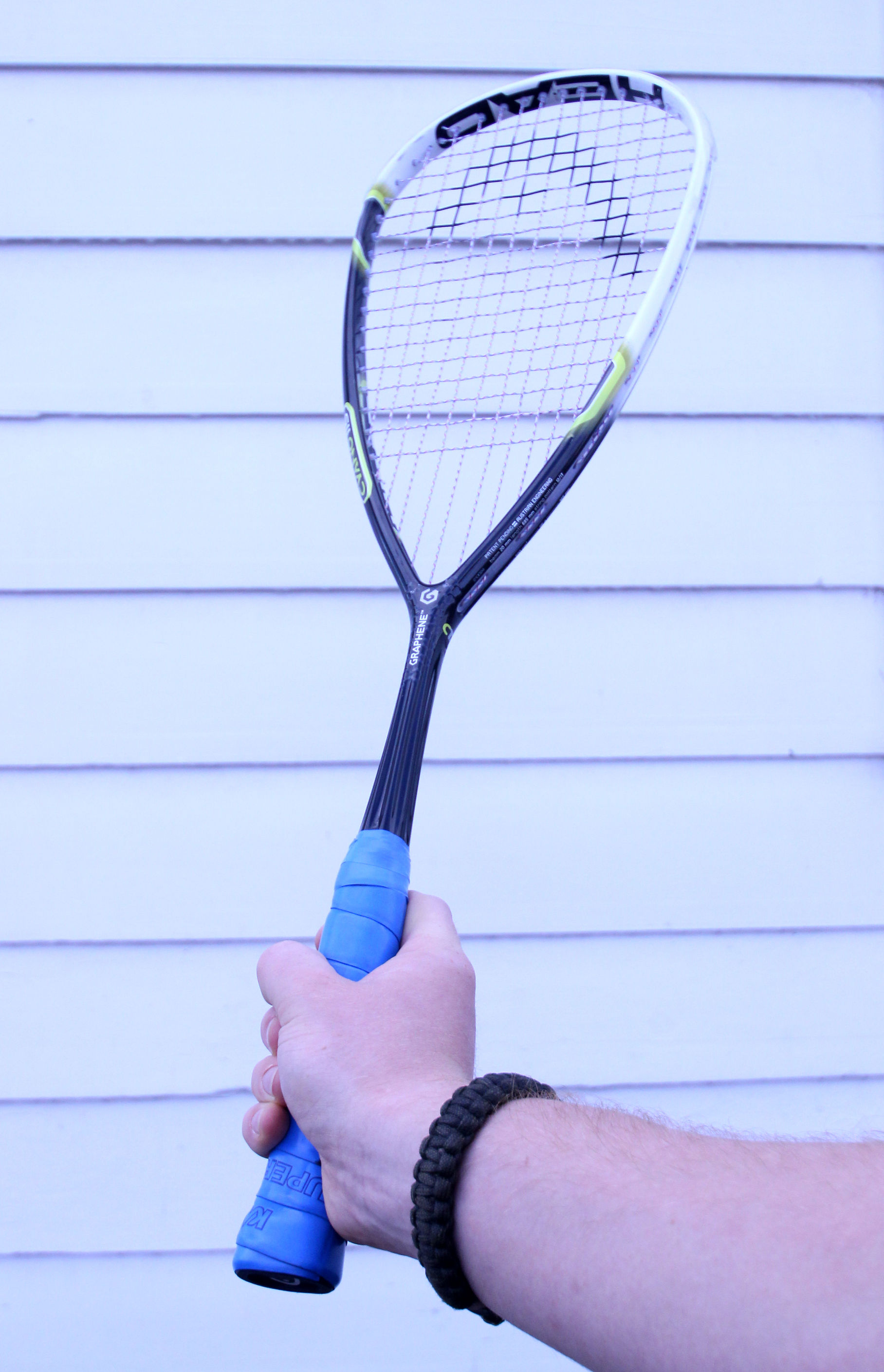
One thing you can do to improve your cross-courts is to hit them with a really open racket face. An open racket face, which your grip should give you if correct, means having the face of your racket you will hit the ball with tilted upwards slightly.

grip a squash racket like this

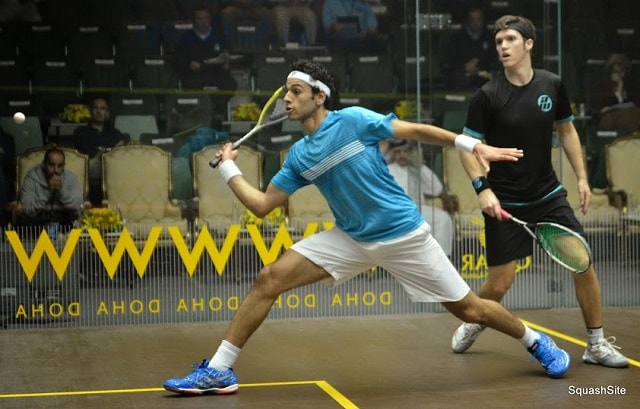
Having a really open racket face puts extra spin on the ball and means the ball comes off the walls slightly differently, especially the side wall. When the ball hits a side wall with a lot of spin, it can really ricochet off the wall nastily, particularly if it has also been hit very hard. Mohamed Elshorbagy is particularly good at this.

Ordinarily, a shot hit very hard would bounce out of the back corners and perhaps set it up nicely for the opponent. However, this combination of a very open racket face and hard hit shot means that you can still hit the ball really hard – perhaps even too hard – as the ball will be slowed down dramatically by the side wall connection and so bounce off the side wall at a nasty angle and not come out of the back much at all.

mohamed-el-shorbagy-min

This means you can attack the cross-court with real pace to get it past the opponent on the T-Position without having to worry about overhitting it so much!

Opening your racket face

You can open your racket face more by changing your grip, but the easiest way is just to rotate your forearm slightly so that your racket is tilted upwards more. This would mean tilting your forearm anti-clockwise or to the left on the backhand and in a clockwise direction, or to the right on the forehand.

Have a go and play about with how open your racket face is when you play cross-courts and see how much spin you can apply to the ball, especially to see what effects this may have when the ball hits the side wall. It really can make your cross-courts stay in the back corner and not come back out.


Filed Under: Tips

Slowing down as you approach the ball


Smooth movement for improved shot and recovery. 

If you find you are having to rely on your speed and make a lot of sprints to retrieve the ball, or that you are rushing your shots, it may be because you are not decelerating properly. You are also not decelerating properly if your shoes make a lot of screeching sounds on the floor!

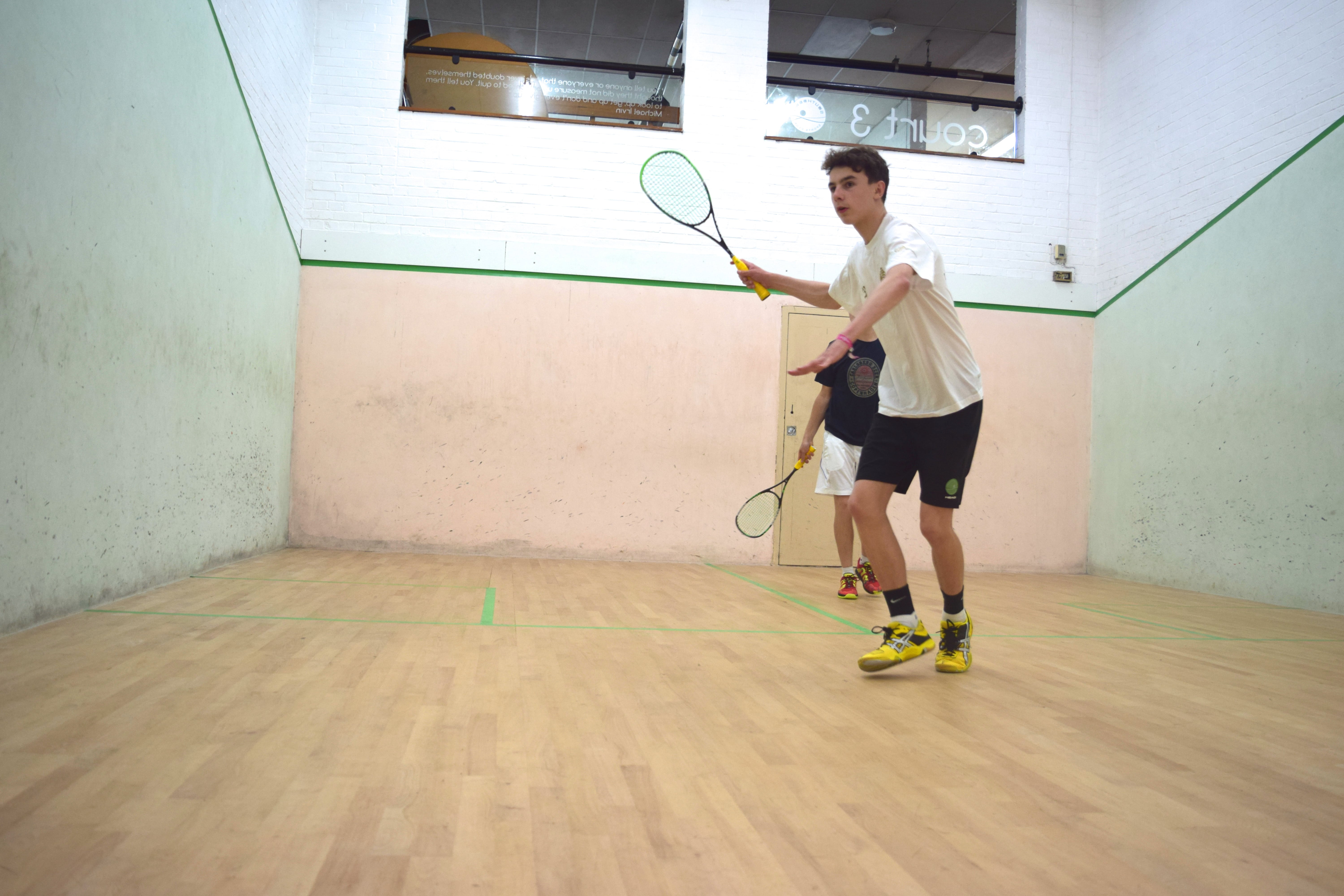
Deceleration is an important part of movement into any shot and should occur as a player starts to get close to the ball they are retrieving. Once a player is a couple of strides away, they should start slowing down their steps by changing their stride length so that their last step will be a stable lunge. This lunge will allow them to transfer their weight for a successful shot but also allow them to push off back to the T-Position using the momentum of the lunge.

Smooth movement for body and game

Deceleration as part of movement can be described using a simple analogy for anyone who drives. Decelerating is like slowing down and going into second gear and rolling gently, before moving off again. Not decelerating is like screeching to an abrupt stop, having to drop to first gear and then having to start back off again from zero. All drivers know which one is safer, healthier for your car and most comfortable!

dsc_0016-min

If you go charging into the ball without slowing down, you will have to slam on the brakes (which won’t be good for your body) and you will not only limit your positioning, you will make it more difficult to recover from your shot. Running at full speed and stopping suddenly is not good for your body. Your knees and Achilles tendons are absorbing that shock and they won’t thank you for it.

If you decelerate as you get to the ball, you are able to slow yourself down and achieve optimal positioning for your shot and lunge in to the ball. Importantly, by slowing down you also aid your movement back to the T-Position, as you are able to push back out of the shot more efficiently, which will help you to get back in position and make it harder for your opponent to make you run. If you come to a complete halt, you have lost momentum and so will have to create new momentum to start moving again and return to the T-Position.

Starting with small strides and increasing the length

The easiest way to decelerate in squash is by taking longer strides. To make achieving longer strides easier, you should look to start your movement with smaller, quicker steps. Players who struggle to slow down and screech all over the court often start off with long steps, which is why they struggle to slow down smoothly. It can also mean they’ll overcommit to shots and so may be vulnerable to sudden changes in direction or disguised shots.

If your shoes are making lots of screeching sounds or you are rushing onto the ball, try to see if you can work in shorter strides to the start of your movement and then increase the stride length to slow down as you get closer to the ball. This should mean you are able to control games more and make your opponent do the running for a change!


Filed Under: Movement, Physical, Positional, Tips

Squash Player Problems Part III: Tall player problems 


Making your height work for you.

Welcome to part three of our squash player problems posts! This week we’ll be looking at how tall players can and need to use their height for them in order to be more effective players.

You can see Squash Player Problems Part I: Fast player problems here and Part II: Skilled player problems here.

Controlling the T-Position 

Tall players typically aren’t the most mobile around the court and rarely have the pace of smaller players, so relying on retrieving shots isn’t really the best way for a tall player to go about playing squash.

Instead, taller players should look to use their height in order to control the T-Position and the game. If a tall player maximises their control of the T-Position, they can control the pace of the game, volley when they want, dominate the central areas of the court and prove very hard to dislodge.

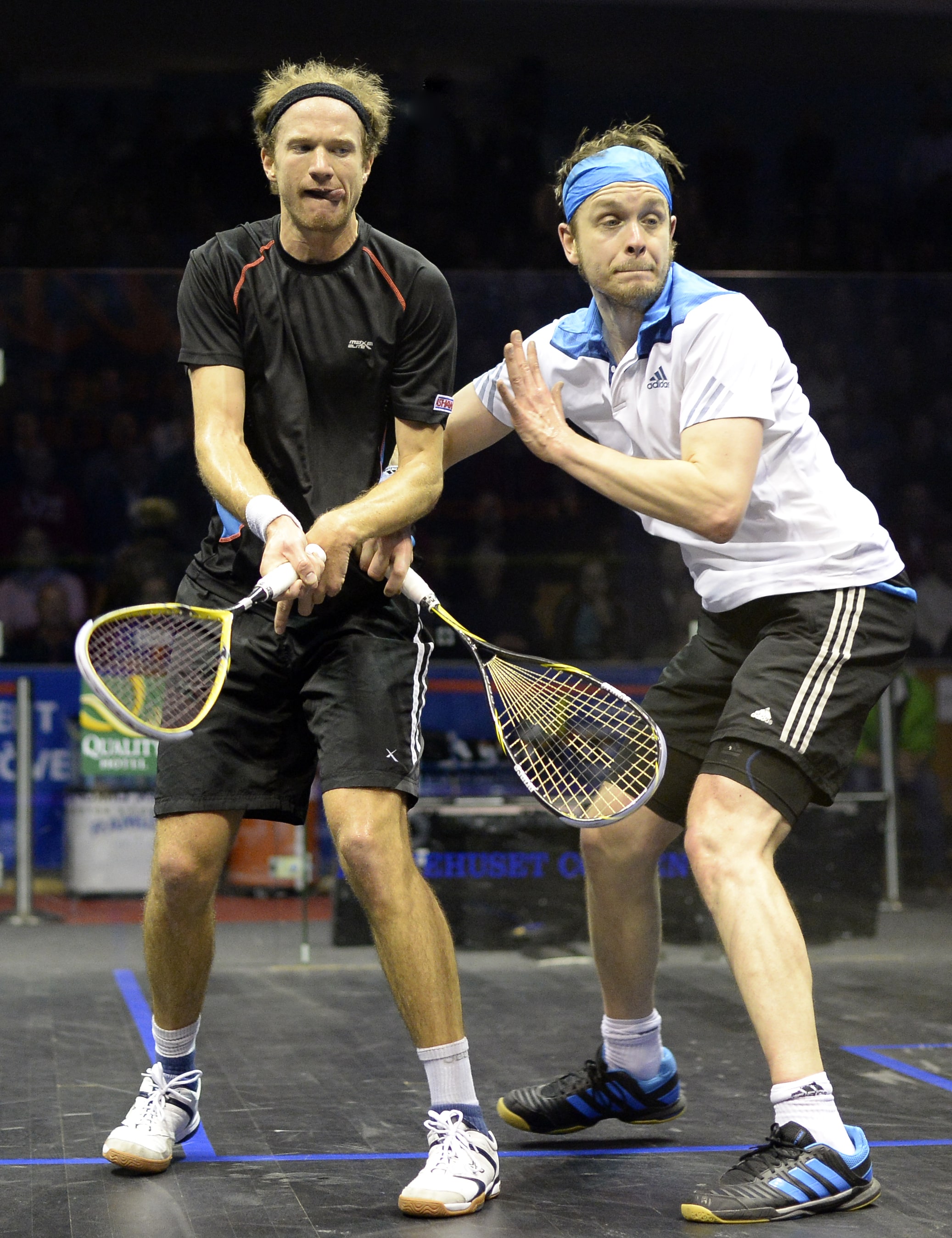
coppwill-min

Therefore tall players should really work on developing their volley skills and ball control on the volley. If they do this, they can become an immovable object on the T-Position. Everyone has played against someone they found next to impossible to remove from the T-Position. This person can be you if you are a tall player; it needs to be you. Tall players are typically less able to rely on retrieving the ball and using pace to stay in the rally and so must seek to be more proactive in the rally than reactive. Reacting to their opponent’s play doesn’t tend to get the same success as with players who have lower centres of gravity.

If you are a tall player, I really recommend developing your volley lob, which you can use to intercept your opponent’s shots and hold onto the T-Position and the drop volley, which is a really flexible attacking shot you can use without too much risk.

Moving as little as possible 

If you’re a tall player, focus on seeing how close you can stay to the central areas of the court. Test yourself and see how far you can stretch into shots. This will enable you to always be very close to the centre of the court and make it very hard for your opponent to find easy gaps to hit the ball into and therefore very hard for them to make you run.

If you are on the taller side, use your height and reach to your advantage; stretch in as much as possible and volley anything and everything you can. Become an immovable object on the T-Position and do your best not to get into a running contest!


Filed Under: Tactical, Tips

Burgess Hill & Sussex Squash contesting court closure

Burgess Hill Squash Club, based at the Triangle Leisure centre, Burgess Hill, Sussex  is showing Olympic spirit in its fight against the closure of its two fantastic exhibition glass back courts. The leisure provider at the centre is planning to close the two glass back courts, located in the centre’s reception area, to make way for a climbing wall as part of a wider redevelopment. If the redevelopment goes ahead, squash at the centre would become untenable and the club would likely have to relocate or disband, as the two remaining courts at the centre aren’t fit for purpose.

The Club is hosting squash and racketball tournaments on Saturday 17th September from 9am onwards to show just how important the courts are to the club and to the wider squash community (If you wish to be involved in this you can contact [email protected]). There may also be other events on the day, which will be publicised as and when details are confirmed.

Meanwhile, representatives of Sussex Squash and Racketball Association remain locked in discussions with the council and have presented a strong case for saving the courts, as well as developing squash at the centre and within the wider area.

This is not just a battle for Burgess Hill Squash Club but for every squash club and player everywhere as courts across the nation face closure. Pressure continues to mount from senseless edicts about making every square meter of space profitable, as if thirty sweaty people plodding through zumba or circuits will produce sporting talent capable of representing this nation.

Please share this message and the story of Burgess Hill Squash Club and show your solidarity for this squash club, as it may not be long before it is your court under pressure. Show that Squash has the Olympic spirit, which is not something that anyone can give or take away from us.

WE WUNT BE DRUV

Filed Under: Tips

  • « Previous Page
  • 1
  • …
  • 6
  • 7
  • 8
  • 9
  • 10
  • …
  • 20
  • Next Page »


Terms | Privacy policy | Contact | About us
Web Development By S G Barker.